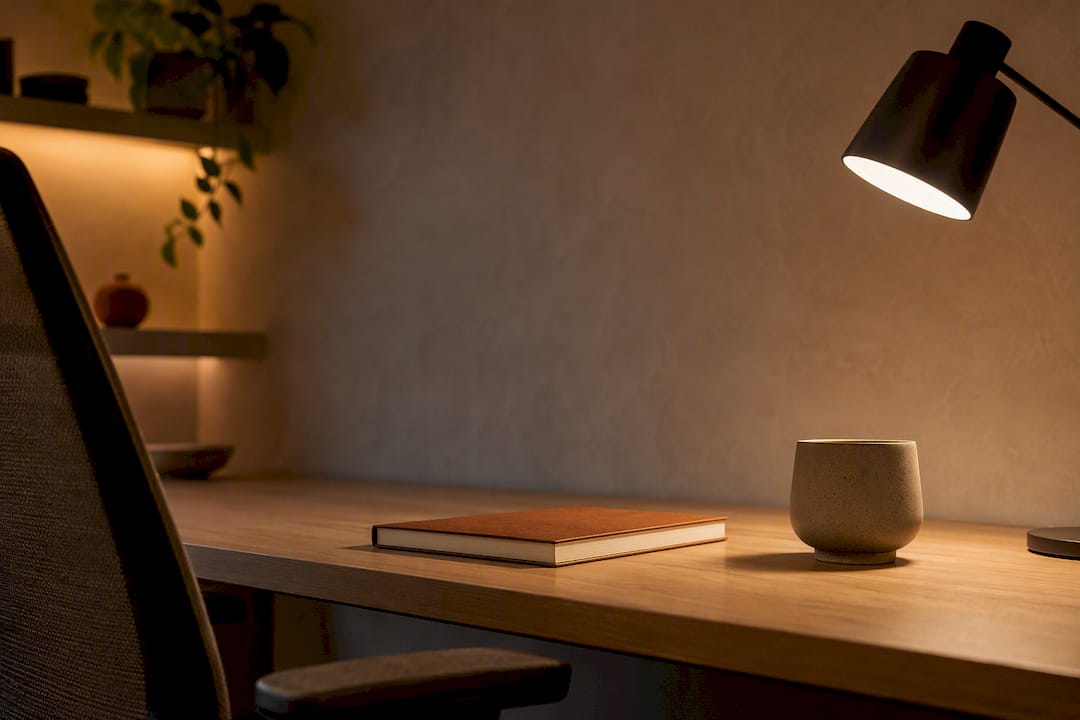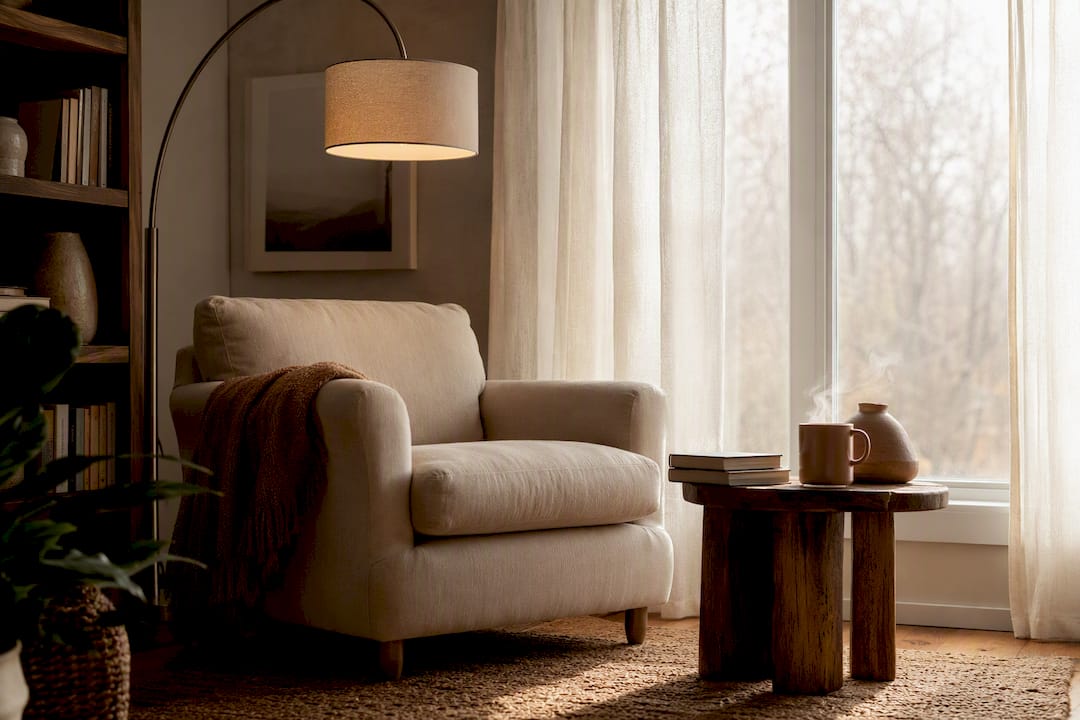
A reading nook does not need many lights. It needs one light that reaches the page without shining into your eyes, plus enough light around the chair that the book does not feel like a bright island in a black room.
Start with placement before buying anything. Move an existing lamp beside the chair, sit in your normal position and open a book. If the page becomes easy to read and the bulb disappears from view, you already know what the new lamp needs to do.
The simple setup
A dependable reading corner has three parts:
- A task light aimed at the book, not the whole room.
- A shade or diffuser that hides the bright bulb from your seated view.
- Dimming or more than one brightness level so the same corner works in late afternoon and at night.
The Illuminating Engineering Society defines task lighting as light directed to the surface where the visual work happens. That distinction matters: a very bright ceiling fixture can make a room look well lit while leaving the page in shadow.
Choose the lamp by the furniture you already have
A table lamp when there is a useful side table
A table lamp is usually the least expensive solution. The table must be tall and close enough that the shade can send light down toward the book. A tiny lamp on a low table may glow pleasantly without doing much for reading.
Look for an opaque or translucent shade with an open bottom. A fully exposed decorative bulb is more likely to produce glare than useful page light.
An adjustable floor lamp when space is tight
A floor lamp works when there is no table or when the chair moves. Swing-arm, pharmacy and adjustable reading lamps let you change where the light lands without dragging the base around.
Large arc lamps can look graceful, but they require floor space and a stable base. Measure the base as carefully as the height, especially beside a recliner or in a walking path.
A plug-in wall light for a fixed nook
A plug-in swing-arm sconce frees the floor and table while avoiding permanent wiring. It is especially useful beside a window seat or built-in bench.
Plan the cord before mounting the fixture. Run it down the wall and along an edge with a listed cord-management product; do not leave it crossing a walkway or trapped where furniture can damage it.
Position the light by looking at the page
There is no universal mounting height. Chair height, shade shape, reader height and lamp beam all change the answer.
Use this test instead:
- Sit exactly as you read.
- Hold the open book or device in its normal position.
- Place the light slightly beside and behind your shoulder.
- Aim it across the page.
- Adjust until your head and hands do not create an annoying shadow.
- Confirm that the bulb itself is hidden from your eyes.
Then change positions. Lean back, turn a page and use both ends of the seat. A lamp that works only while you sit perfectly upright is not finished.
If two people share a loveseat, one centered arc lamp often creates shadows. Two modest, separately controlled lights usually work better.
Choose brightness you can adjust
Lumens describe how much light a lamp or bulb produces; they do not tell you how much reaches the page. Distance, shade shape, beam spread and surrounding surfaces all change the result.
For a replaceable-bulb lamp, an 800-lumen A19 bulb is a sensible household starting point when paired with dimming. A focused reading lamp may need less total output because it sends more of that light toward the book. Someone reading small print may want more.
The useful feature is control. Choose one of these:
- a lamp with a built-in dimmer;
- a replaceable bulb marked dimmable plus a compatible plug-in dimmer; or
- a smart bulb kept on full wall power and dimmed through its app or a compatible wireless control.
Do not connect a smart bulb to a conventional external dimmer. The smart bulb or plug-in dimmer comparison explains the two complete setups.
Use warm light without making the page muddy
For a nook used in the evening, begin with 2700K or 3000K. Both can feel warm in a home; the room’s paint, wood and shade material influence which looks better.
Choose a bulb with a color-rendering index of 90 or higher when possible. Good color rendering helps illustrations, textiles and skin tones look convincing, although CRI is not a complete description of light quality.
If the nook also supports detailed crafts, paperwork or daytime work, a tunable-white bulb can be useful. Use its cooler setting because it helps the task—not because every reading session requires “daylight” color.
The warm LED bulb buying guide covers bulb bases, lumens, CRI and dimmer compatibility in more detail.
Leave some light around the chair
A page can feel glaring when it is much brighter than everything around it. Keep one quiet source elsewhere in the room: a shaded lamp, a dim wall light or indirect light on a shelf.
This background layer does not need to illuminate the book. Its job is to soften the transition when you look up. It is the same principle used throughout layered lighting, scaled down to one chair.
A renter-friendly setup under $50
Work in this order:
- Move a lamp you already own beside the chair.
- Fit it with a warm, high-CRI bulb of appropriate base and wattage.
- Add compatible dimming if the lamp is useful but too bright.
- Buy a new lamp only if the existing fixture cannot put light on the page or hide the bulb.
This sequence prevents a common mistake: buying an attractive accent lamp that creates atmosphere but still leaves you straining to read. The under-$50 living-room lighting plan includes complete bulb, dimmer and lamp paths.
What to check before buying
- The lamp directs light downward or can be aimed at the page.
- The bulb is concealed from your seated line of sight.
- The switch or dimmer is reachable without standing up.
- The base does not interfere with a recliner, ottoman or walking path.
- The socket label supports the bulb base and wattage.
- Any integrated LED has replaceable parts or a warranty you consider reasonable.
- The cord reaches a wall outlet without an unsafe route.
Fix the setup that is almost right
| Problem | Try this first |
|---|---|
| The page is dim | Move the light closer or aim it more directly before adding lumens |
| The bulb is visible | Lower or rotate the shade; use a deeper shade or diffused bulb |
| Your head casts a shadow | Move the light farther to the side and slightly forward or back |
| The room feels harsh | Dim the task light and add a quiet background source |
| The light feels yellow | Try 3000K, or compare the shade and wall colors before blaming the bulb |
| The lamp is always at the wrong level | Choose an adjustable arm rather than a brighter fixed lamp |
The right reading light does not announce itself. The page is easy to see, the rest of the room remains calm, and the lamp feels as though it belongs beside the chair.