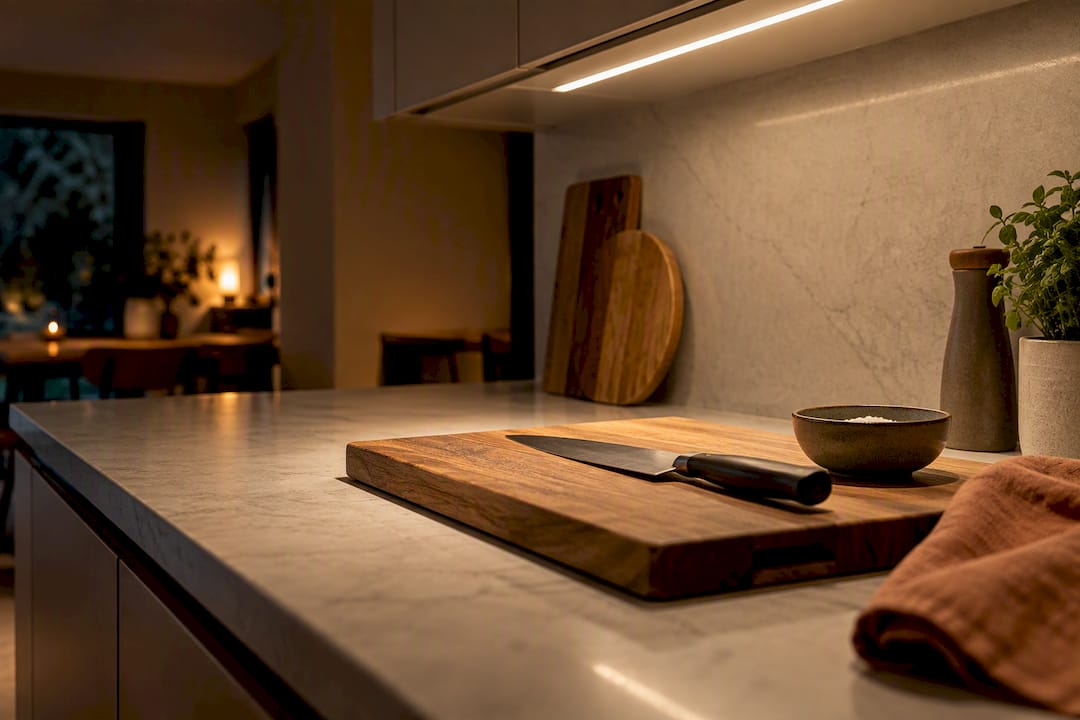
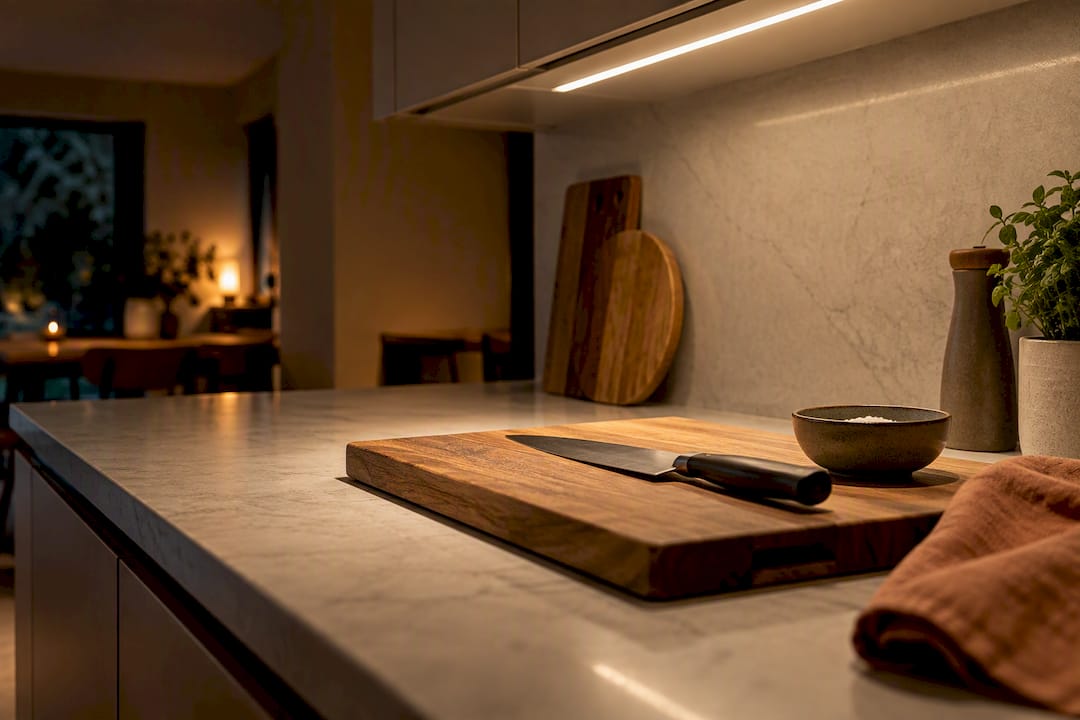
For most kitchens, LED linear or strip under cabinet lighting is the right call. It spreads light evenly across the counter, runs cool and cheap for years, and outlasts older lamp types by a wide margin. Battery or plug-in kits handle simple upgrades without any wiring; hardwiring gives you a cleaner look but usually needs an electrician if it involves a new circuit or in-wall switch.
TL;DR:
- LED strip lights or light bars are the best choice for even, task-oriented under cabinet lighting because they provide consistent coverage and last over 50,000 hours.
- For DIY installations, battery and plug-in kits are straightforward and suitable for renters, while hardwired systems require planning and professional wiring, especially when integrating into new circuits.
- To prevent flickering or color mismatch, ensure connections are secure, use fixtures from the same brand and CCT batch, and keep drivers ventilated to prolong LED lifespan.
- Mount lighting toward the front-middle of the cabinet underside to maximize the usable light on countertops and consider aluminum extrusions and diffusers for even, glare-free illumination.
- For optimal brightness, aim for 200 to 500 lumens per foot with a CRI of 90 or higher, matching color temperature to cabinet finish for accurate color rendering.
Table of Contents
- What Are the Main Types of Under Cabinet Lighting?
- How Do You Choose the Right Under Cabinet Lighting?
- How Do You Install Under Cabinet Lighting Yourself?
- Battery, Plug-In, or Hardwired: Which Power Option Fits?
- How Bright Should Under Cabinet Lighting Be?
- Where Should You Mount and How Do You Avoid Dark Spots?
- Do Under Cabinet Lights Work With Smart Home Controls?
- Why Do Under Cabinet Lights Flicker or Look Mismatched?
- What Under Cabinet Lighting Teaches You About Layered Design
- Get More Curated Lighting Guidance From TheconnectedDwelling
- Sources
- FAQ
What Are the Main Types of Under Cabinet Lighting?
Three lamp technologies have historically shown up under kitchen cabinets: incandescent, fluorescent, and LED. LED has become the default because it uses far less energy and can run more than 50,000 hours before it needs replacing, compared to the short life and heat output of incandescent bulbs. Beyond the lamp itself, the hardware comes in a few distinct shapes.
- Linear light bars and strip lights spread light along the whole cabinet length, which is why they're the go-to for task lighting over a stretch of counter.
- Puck lights throw a rounder, more concentrated beam. They're better for highlighting a backsplash or a specific zone than for even counter coverage, and you'll often need several to avoid dark gaps.
- Light pads and integrated fixtures are flatter, panel-style options that sit flush against the cabinet bottom. They're less common but worth a look if you want something closer to a built-in fixture than a visible strip.
For pure task lighting, strips win on consistency. For accent work, pucks give you more punch in a smaller footprint.
How Do You Choose the Right Under Cabinet Lighting?
Start by naming the job. A light meant to help you chop vegetables safely needs different specs than one meant to create ambience for evening cooking. Here's a simple sequence to work through:
- Define the goal first. Task lighting needs even, bright coverage; accent lighting can be dimmer and more directional; a night light just needs to be low and unobtrusive.
- Measure your cabinet depth and mounting spot. Shallow cabinets and wide counters need wider light spread than narrow upper cabinets over a tight run.
- Pick color temperature by finish. Warm wood tones look best under 2700 to 3500K light, while glass, white, or stainless surfaces read more true to color under 3500 to 5000K. Our guide to 2700K versus 3000K breaks down how that shift changes a room's mood.
- Set your budget against maintenance and control needs. Battery units cost less upfront but need recharging; hardwired systems cost more but need almost no attention once installed.
Working through these four steps in order keeps you from buying a beautiful fixture that's wrong for the job.
How Do You Install Under Cabinet Lighting Yourself?
Battery and plug-in kits are genuinely DIY-friendly. Editorial testing from The Spruce confirms these no-wiring options are a solid first upgrade for renters and anyone who wants results without touching a breaker box. Hardwired systems are a different animal.
- Measure and plan first. Note the cabinet's length, depth, and any obstacles, then decide whether you're mounting with adhesive, clips, or screws.
- Test before you commit. Plug in or power up the fixture on the counter first to confirm brightness and color before it's mounted for good.
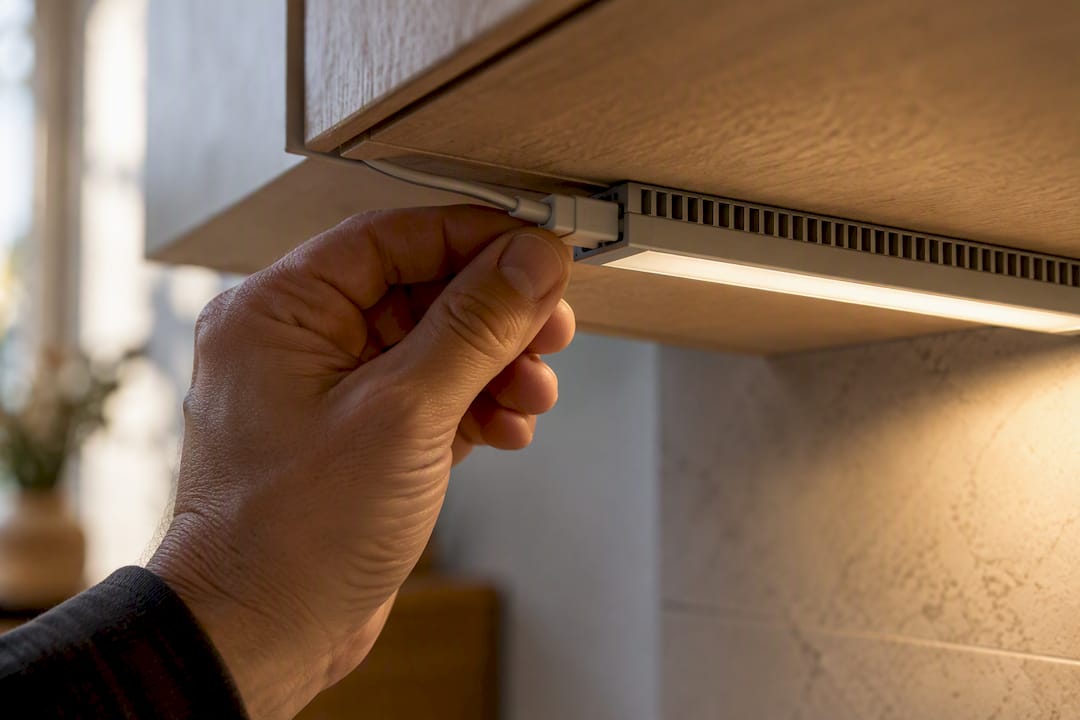
- Mount and route the cord. Attach the fixture toward the front-middle of the cabinet bottom, then run the cord along the cabinet's inside edge or through a small drilled channel to keep it out of sight.
- For hardwired setups, plan for a driver. Low-voltage systems need a transformer or driver, often tucked inside a cabinet, plus access to a junction box or existing circuit.
Hire an electrician if the project involves hardwiring into a new circuit, adding an in-wall switch, or any wiring you're not fully comfortable tracing yourself. Miswired low-voltage runs are usually just annoying; miswired line-voltage work is a real safety risk.
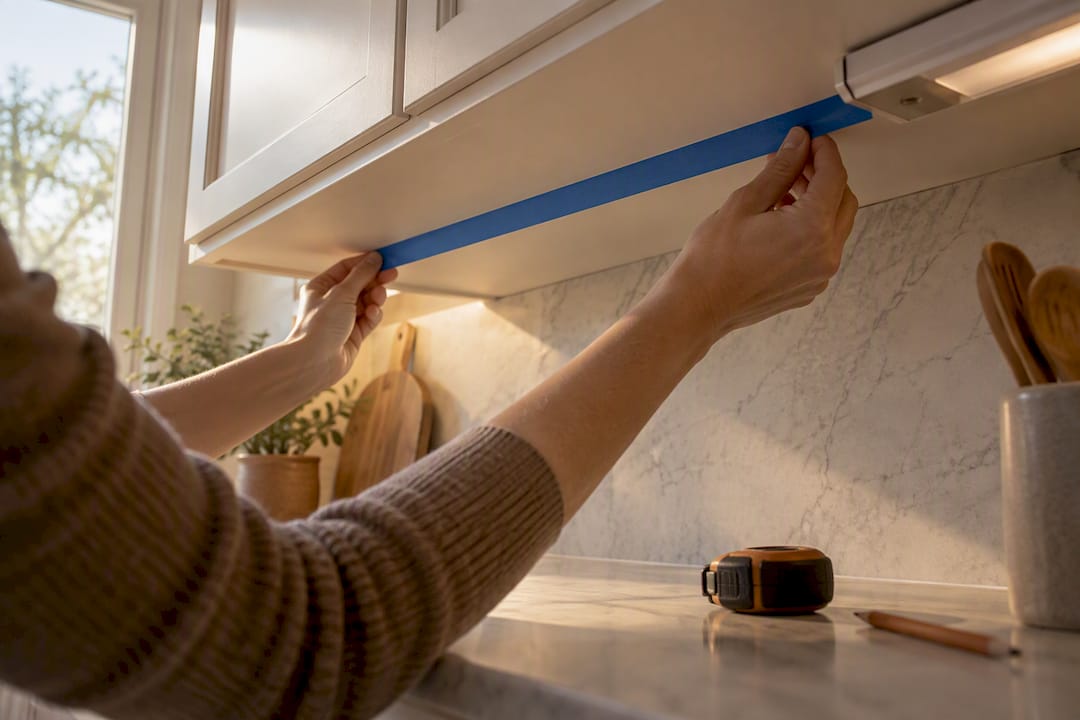
Pro Tip: Stick painter's tape along your mounting line before installing anything. It gives you a straight, removable guide and saves you from adhesive strips going on crooked the first time.
Battery, Plug-In, or Hardwired: Which Power Option Fits?
Each power option trades convenience for permanence in a different way.
- Battery and rechargeable units need no wiring at all, which makes them the easiest to install and remove. The tradeoff is upkeep: batteries need swapping or recharging every few weeks depending on use.
- Plug-in strips are nearly as simple and generally brighter and more consistent than battery units. The main challenge is hiding the cord, which usually means routing it behind the cabinet or down into an outlet drilled discreetly into the wall.
- Low-voltage hardwired systems run on a driver or transformer, typically at 12V or 24V, with 24V often preferred for longer runs because it loses less voltage over distance.
- Heat and driver placement matter regardless of voltage. Keep drivers ventilated and confirm your fixture, driver, and any dimmer are all rated to work together before you buy.
If you're renting or just testing the idea, start with plug-in. If you're renovating and want it invisible, hardwired is worth the extra planning.
How Bright Should Under Cabinet Lighting Be?
Aim for 500 lux on your countertop. That's the Illuminating Engineering Society's recommendation for kitchen counters and other spots where you're doing precise work like chopping or reading a recipe. In practical terms, that translates to roughly 200 to 500 lumens per foot of cabinet run, with darker countertops and deeper counters pushing you toward the higher end of that range.
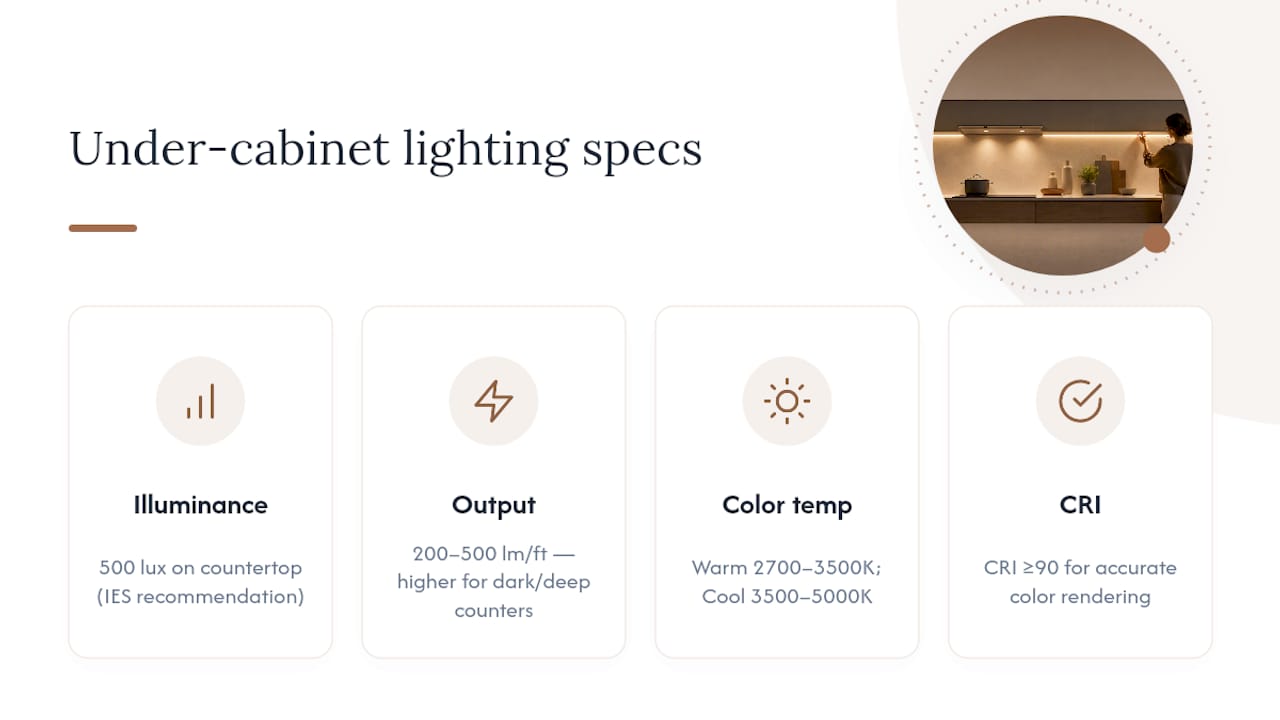
Color temperature should match the job and the finish, as covered above: warmer 2700 to 3500K for wood, cooler 3500 to 5000K for stainless or glass. One spec worth checking beyond lumens and CCT is CRI, or color rendering index. A CRI of 90 or higher shows food and finishes in their true colors instead of a slightly washed-out or greenish cast, which matters more under a strip light six inches from your cutting board than it does in an overhead fixture across the room.
Where Should You Mount and How Do You Avoid Dark Spots?
Placement matters as much as the fixture itself. Strips mounted too close to the back wall lose beam spread because of the LED's natural beam angle, which leaves the front edge of the counter dimmer than it should be.
- Mount toward the front-middle of the cabinet underside, not tucked against the back, for the widest, most usable pool of light on the counter.
- Use aluminum extrusions on longer runs. They prevent the scalloped, spotty look raw LED strips can produce and double as a heat sink that extends the diode's lifespan.
- Add a diffuser lens if you notice individual LED dots through the extrusion; frosted covers smooth that out into one continuous line.
- Plan seams before you cut. For long cabinet runs, decide where strips will connect and keep polarity consistent across every connector so the whole run lights evenly.
Do Under Cabinet Lights Work With Smart Home Controls?
Smart control is optional, not essential, and it adds a layer of complexity worth weighing honestly.
- Confirm dimmer compatibility before buying a dimmer. Not every LED driver plays well with every dimmer switch, and mismatches cause flicker or a limited dimming range.
- Motion sensors and simple remotes suit most kitchens fine, especially for lights you just want on or off without app setup.
- Full smart integration (matched to something like smart bulbs versus smart switches) gives you scheduling and voice control but adds a hub, app, and network step to the install.
- Smart drivers take up more cabinet space than a basic transformer, so factor that into tight installs.
Why Do Under Cabinet Lights Flicker or Look Mismatched?
Flicker almost always traces back to one of three things: an incompatible dimmer, a loose connection, or a driver that's undersized for the run. Check connections first; it's the easiest fix and the most common cause.
Color mismatch between fixtures usually means you mixed CCT ratings or bought from different manufacturing batches. Stick to one CCT and one supplier per visible run to avoid it. LEDs themselves rarely burn out outright, but heat buildup shortens their life, so keep extrusions ventilated and avoid enclosing drivers in airtight boxes. If flicker persists after checking the basics, or if you smell heat or notice discoloration near the driver, call an electrician rather than troubleshoot further yourself.
What Under Cabinet Lighting Teaches You About Layered Design
Under cabinet lighting is task lighting, but it's also the workhorse layer that makes a kitchen's ambient and accent lights make sense. Get it right, and the room reads calmer even before you touch the overheads. Our layered lighting guide walks through how these layers work together.
The best installs disappear. Extrusions painted to match the cabinet, cords tucked out of sight, warm CCT chosen to match the wood: none of it should announce itself. That restraint is the real skill.
Get More Curated Lighting Guidance From TheconnectedDwelling
This resource is for homeowners who want lighting decisions explained, not just a parts list. It focuses on why a color temperature or mounting spot works for your specific kitchen, which is the piece most product pages skip entirely.

If under cabinet lighting has you thinking about the rest of your kitchen or living space, our lighting hub has curated guides on everything from color temperature to full layered lighting plans. Start with the Beginner's Guide to Layered Lighting to see how task, ambient, and accent light work together in one coherent plan, then come back to this guide when you're ready to shop specs with confidence.
Sources
- Under-cabinet lighting — Wikipedia
- 7 Under-Cabinet Lighting Options to Upgrade Your Kitchen — The Spruce
- How to Choose and Install Under Cabinet Lighting Using LED Strip Lights - FlexfireLEDs
- Under Cabinet LED Lighting – aspectLED
FAQ
What lights are best for under cabinets?
LED linear strips or light bars are the best choice for most kitchens because they spread light evenly across the counter and last far longer than incandescent or fluorescent alternatives. Look for 200 to 500 lumens per foot and a CRI of 90 or higher for accurate color.
Do you need an electrician to install under cabinet lighting?
Not for battery or plug-in kits, which most homeowners install themselves in an afternoon. You typically need an electrician for hardwired systems that tap into a new circuit, require an in-wall switch, or involve wiring you're not confident tracing.
What are the best under cabinet kitchen lights?
For task lighting, linear LED strips or bars mounted toward the front-middle of the cabinet give the most even counter coverage. For accent highlighting, puck lights work well in smaller doses, and plug-in or battery options are the easiest entry point if you want to test the look before committing to a hardwired setup.
What is under-cabinet lighting called?
It's most commonly called under cabinet lighting or under-counter lighting, and the fixtures themselves are usually referred to as LED strip lights, light bars, or puck lights depending on their shape. All three terms describe the same basic category of task lighting mounted beneath upper cabinets.