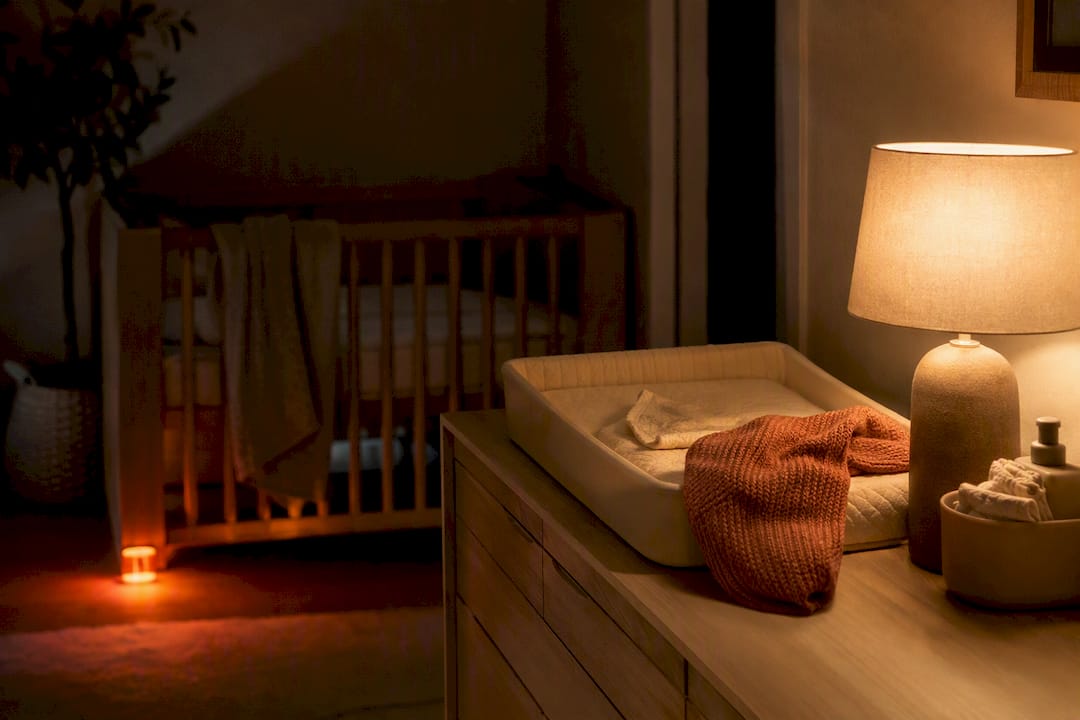
Nursery lighting needs to help an adult see clearly during the day and move through overnight care without flooding the room with light. A ceiling fixture alone rarely handles both jobs well. A dimmable main light and one carefully placed lamp or nightlight give you more useful control.
Lighting can support a calm nighttime routine, but it cannot promise fewer wakings. The American Academy of Pediatrics notes that frequent waking is normal for young babies and advises keeping nighttime interactions quiet and the lights dim.
Plan the room around three settings
Think about the room at the times you will actually use it.
| Setting | What the light needs to do | A practical starting point |
|---|---|---|
| Daytime care | Make cleaning, dressing and organizing easy | The main ceiling light at full output |
| Evening routine | Light the chair or changing area without lighting every corner | A shaded lamp or dimmed wall light |
| Overnight care | Provide enough visibility to move and care for the baby safely | The lowest useful dimmer setting or a small, shielded nightlight |
The exact fixture count depends on the room. In a compact nursery, a dimmable ceiling fixture and one local light may be enough. A larger room may need separate light near the chair and changing area.
Our beginner’s guide to layered lighting explains how ambient and task lighting work together.
Handle cord safety before choosing a lamp
The Consumer Product Safety Commission recommends cordless window coverings in homes with young children. It also advises moving cribs, beds, furniture and toys away from windows and window-covering cords. The same page warns parents to keep all cords away from babies, including baby-monitor cords.
Apply that guidance to the lighting plan:
- Keep lamp, nightlight and monitor cords well outside the crib area.
- Do not run a cord between the crib and the wall or leave a loop where a child could reach it.
- Choose cordless shades when adding blackout or light-filtering window coverings.
- Put a portable lamp on a stable surface where it cannot be pulled over as the baby becomes mobile.
- Follow the fixture manufacturer’s bulb, mounting and clearance instructions.
Use a qualified electrician for a new wall dimmer, sconce or other hardwired work. A plug-in light is the simpler option when the room is rented or the wiring is uncertain.
Lighting is only one part of a safe nursery. The AAP’s safe-sleep guidance covers the sleep surface, bedding, room sharing and other decisions that a lighting guide cannot.
Choose brightness by testing the real task
There is no useful universal lumen target for a nursery nightlight. A bulb behind an opaque shade behaves differently from the same bulb in an exposed fixture, and light-colored walls reflect more light than dark ones.
Test the room after sunset. Begin with the lowest setting, then raise it until you can walk, feed or change the baby without straining. The light should be shielded from the crib and from the adult’s normal seated view. If you can see the bare bulb from the chair, reposition the fixture or choose a deeper shade.
The AAP recommends dim lights before bedtime and dim lighting during nighttime feedings. It does not prescribe a particular lumen level or require an amber or red bulb. A low, warm-white setting is a practical choice because it feels less glaring than a bright overhead light, but it should still provide enough visibility for safe care.
Use color temperature as a design choice
A 2700K warm-white bulb is a sensible starting point for an evening lamp. A 3000K bulb can also work, especially in a room with white walls or when the same fixture is used for daytime tasks. Color temperature describes the appearance of the light, not its brightness.
Consistency matters more than chasing a precise number. Two nearby fixtures at noticeably different color temperatures can make the room feel unsettled. Start with the bulb already in the room, compare it at night and change one source at a time.
If you are choosing between the two common warm-white options, see our guide to 2700K versus 3000K lighting.
Make the controls easy to use
A dimmer is useful when one fixture must handle both cleaning and nighttime care. Confirm that the bulb and fixture are dimmable and compatible with the control. Poor combinations can flicker, buzz or fail to dim low enough.
Put the control where an adult can reach it before crossing the dark room. A physical wall dimmer or lamp control is dependable and easy for another caregiver to understand. Smart bulbs can add schedules or presets, but the room should still have a simple manual way to turn on useful light.
Do not connect a smart bulb to a conventional lamp dimmer unless the manufacturer explicitly supports that arrangement. Most smart bulbs expect constant full power and perform their own electronic dimming.
Decide whether you need blackout shades
Blackout lining can make a bright room darker for daytime naps. It is optional, and it does not replace a consistent routine. If you add a window covering, prioritize a cordless design and keep the crib and climbable furniture away from the window.
Before ordering, check how the shade will be operated, whether light leaks around the edges matter in your room and whether the window still needs ventilation or an unobstructed exit.
A short shopping order
Buy only what solves a problem you have observed in the room.
- Check the window coverings and every existing cord near the crib.
- Add a compatible dimmer to the main fixture if its full output is too bright at night.
- Add one shaded local light where overnight care happens.
- Consider cordless blackout shades if daylight control is still a problem.
- Add smart controls only when a schedule or preset would make the room easier to use.
Test each setting after dark before adding another fixture. Sit in the feeding chair, stand at the changing area and check the view from the crib. The placement problem usually becomes obvious from those three positions.
Common questions
What color temperature works well in a nursery?
Start with 2700K for a warm evening lamp. A 3000K source can be useful for a ceiling fixture that also supports daytime care. Treat these as design starting points rather than sleep prescriptions.
How bright should a nursery nightlight be?
Use the lowest setting that still lets an adult move and complete the task safely. Shade design, placement and wall color make a fixed lumen rule unreliable.
Will a nightlight help a baby sleep through the night?
No lighting choice can promise that result. The AAP explains that young babies normally wake often. Dim light and quiet interaction can keep nighttime care less stimulating.
Are smart bulbs useful in a nursery?
They can be useful for scheduled dimming or a saved low-light setting. Keep a straightforward manual control available and confirm that the bulb is compatible with the fixture.
Where should a nursery lamp go?
Place it near the task it serves, on a stable surface, with the bulb shielded from direct view. Keep the lamp and its cord outside the crib area and beyond a child’s reach.