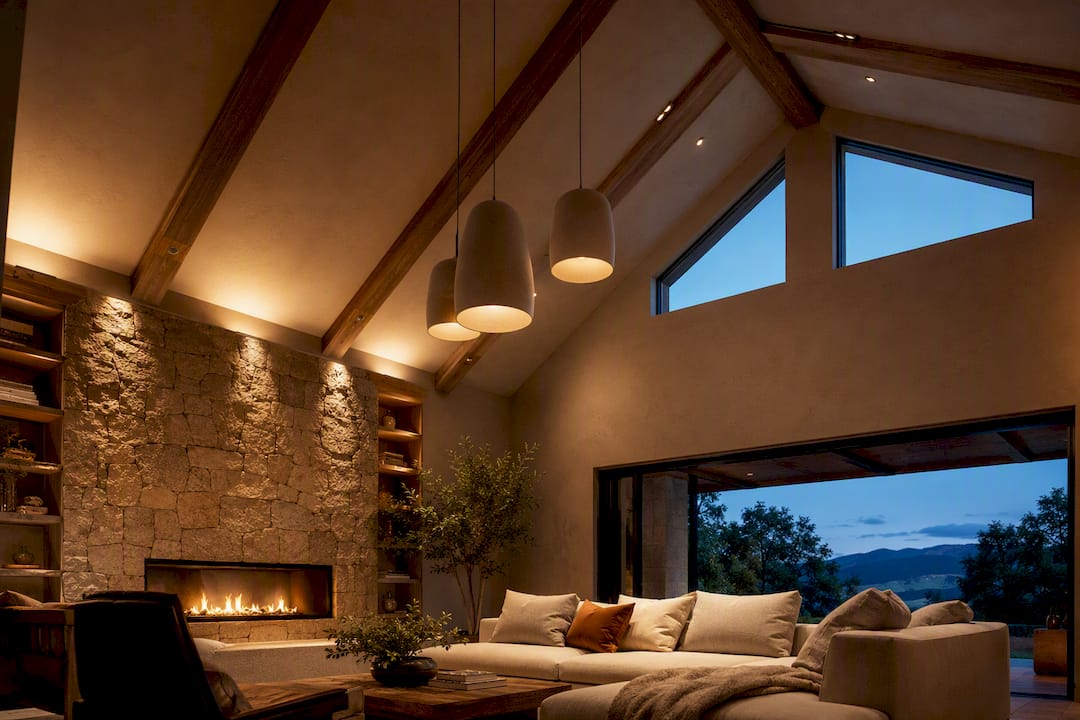
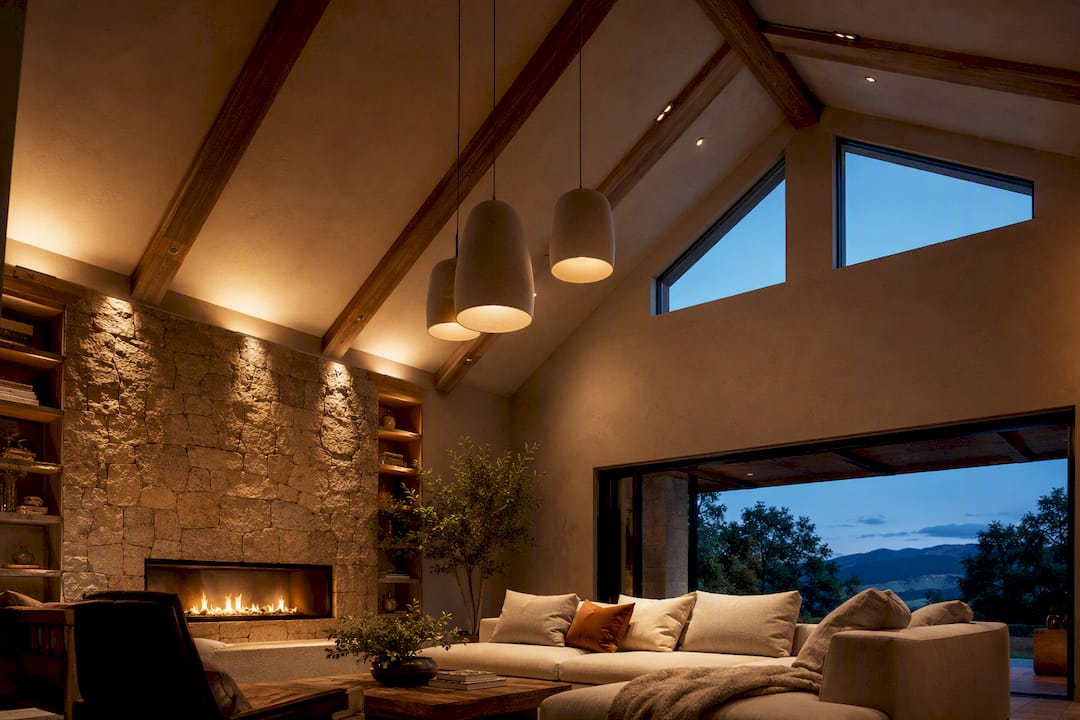
Layered lighting is the fastest way to make a vaulted ceiling feel intentional instead of cavernous: a statement pendant or chandelier for scale, sloped-rated recessed or track fixtures for ambient fill, and wall sconces for uplight on the angled planes. Keep everything on dimmers between 2700K and 3000K, and plan service access before you buy anything heavy.
TL;DR:
- Layered lighting with dimmable fixtures in warm tones is essential for balancing scale, ambiance, and visual interest in vaulted ceilings.
- Proper fixture sizing relies on adding room dimensions in feet to determine chandelier diameter, with a standard hanging height of 30 to 36 inches above the table.
- Recessed and track lighting should be rated for sloped ceilings, with flexible systems like magnetic tracks offering up to 30% better light distribution.
- Electrical and structural access planning upfront prevents maintenance issues, especially for heavier fixtures requiring lowering devices or reinforced mounts.
- Costs vary widely but budgeting for fixture flexibility, proper mounting, and future-proof controls can save money on repairs and upgrades later.
Table of Contents
- Vaulted Ceiling Lighting: Comparing Your Fixture Options
- How Do You Size and Hang Fixtures for a Vaulted Ceiling?
- Choosing Bulbs, Dimmers, and Smart Controls for High Ceilings
- Installation and Maintenance: What to Plan Before the Work Starts
- Insights from experience with vaulted rooms
- Do vaulted ceilings affect lighting costs?
- Budgeting for Fixtures and Installation
- Design Styles That Work With Vaulted Ceilings
- Integrating Smart Controls With Vaulted Ceiling Fixtures
- Editorial Take: What the Scale Rules Don't Tell You
- Let TheconnectedDwelling Help You Plan the Room, Not Just the Fixture
- Sources
- FAQ
Vaulted Ceiling Lighting: Comparing Your Fixture Options
Every vaulted room needs more than one fixture type working together, but the mix depends on the room's shape, ceiling pitch, and how much natural light it already gets. Here's how the main categories stack up against each other.
Pendants and chandeliers anchor the room and give your eye something to land on in a space that otherwise reads as "just tall." They need a swivel canopy or sloped ceiling adapter to hang straight on an angled surface, and they're the least forgiving to install wrong. A single small pendant gets visually lost in a high room. Grouping two or three smaller pendants so they read as one composition works better than a lone fixture at scale.
Sloped-rated recessed lighting disappears into the ceiling plane and handles ambient fill without competing with a chandelier overhead. It requires housings specifically rated for angled installation, not standard cans tilted into a slope. Maintenance is easy since there's nothing to dust, but aiming is fixed once installed unless you choose gimbal or eyeball trims.
Track and magnetic track systems offer the most flexibility of any option on this list. Magnetic track in particular lets you reposition heads as your furniture layout changes, and properly placed systems can improve effective light distribution by up to 30% compared to fixed can lights.
Wall sconces solve the problem nothing else does well: lighting the sloped walls themselves so they don't fall into shadow.
| Fixture type | Best for | Mounting needs | Adjustability | Visual effect | Maintenance | Typical price range |
|---|---|---|---|---|---|---|
| Pendant/chandelier | Focal point over dining or seating | Swivel canopy for slope | Fixed once hung | Statement, formal or rustic | Moderate, may need lowering system | $200 to $2,500 or more |
| Sloped recessed | General ambient fill | Sloped-rated housing | Low, unless gimbal trim | Clean, minimal | Low | $30 to $120 per fixture |
| Track/magnetic track | Flexible accent and ambient | Surface or magnetic rail | High, repositionable | Modern, gallery-like | Low | $150 to $600 per system |
| Wall sconce | Uplight on angled walls | Standard junction box | Fixed direction | Warm, dimensional | Low | $60 to $300 each |
How Do You Size and Hang Fixtures for a Vaulted Ceiling?
Getting the scale right is where most vaulted ceiling projects go wrong before the electrician even shows up. Buy a chandelier too small and it looks like an afterthought floating in space. Buy one too large and it dominates a room meant to feel open.
The sizing formula lighting designers rely on is simple: add your room's length and width in feet, and use that sum in inches as your starting chandelier diameter. A living room sized for typical large living spaces points you toward a fixture roughly medium to large in diameter. From there, hanging height follows a standard dining-height rule of 30 to 36 inches above the table, with an added 3 inches of drop for every foot your ceiling exceeds 8 feet.
Pro Tip: Chalk out your fixture's diameter on the floor with painter's tape before you order anything. Standing in the room with that footprint marked out tells you more than any spec sheet.
For recessed lighting, space fixtures at roughly ceiling height divided by two, and keep them 2.5 to 3 feet from walls so you're not washing the wallpaper instead of the room.
Before you call an electrician or order fixtures, gather this information:
- Room length, width, and peak ceiling height
- Ceiling pitch angle if known, or a photo showing the slope
- Location of existing junction boxes and whether they're structurally rated for a heavy fixture
- Switch and dimmer locations you want, including three-way switching if the room has two entrances
- Fixture weight and mounting hardware requirements from the manufacturer spec sheet
Choosing Bulbs, Dimmers, and Smart Controls for High Ceilings
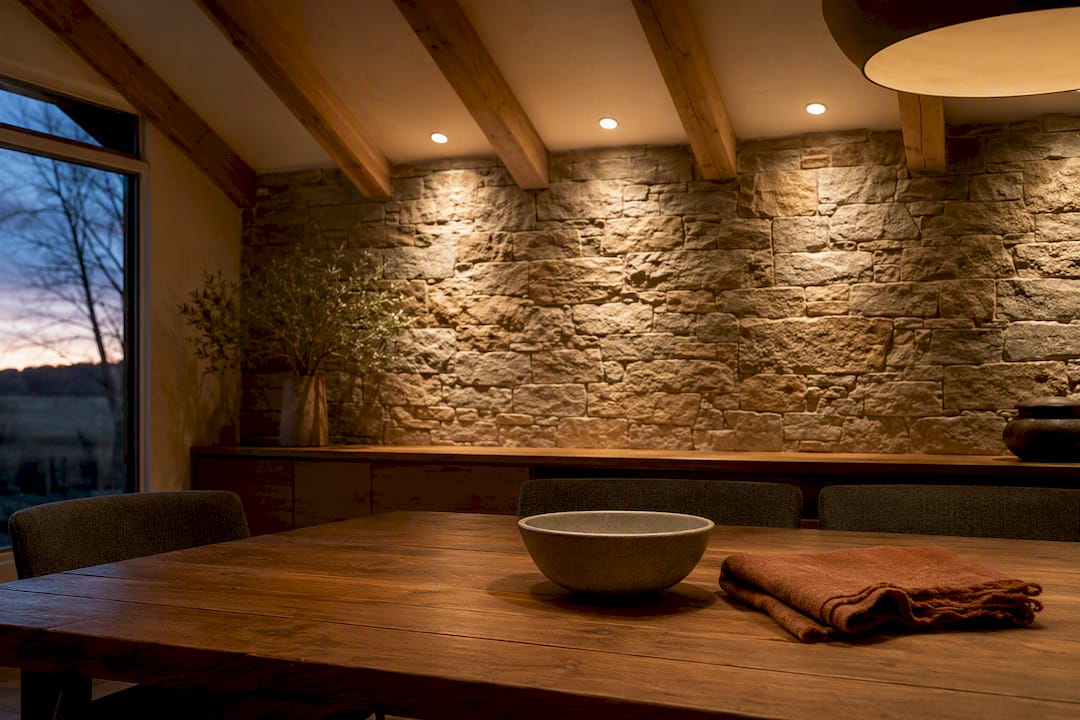
Color temperature matters more in a vaulted room than a standard one because the extra volume of space makes cool light feel clinical fast. Stick with 2700K to 3000K across every fixture in the room, and keep the spread within about 300K of variance so wood tones and wall colors don't shift between fixtures. Aim for CRI 90 or higher if you have real wood beams, stone, or warm paint finishes you want rendered accurately.
Dimmers introduce their own headaches in high-ceiling installs. LED fixtures paired with the wrong dimmer type cause flicker or uneven fade, usually from a minimum load mismatch or an incompatible electronic transformer.
A few things worth doing before your electrician leaves:
- Test the exact fixture, LED lamp, and dimmer combination together, not just each piece individually.
- Choose long-life LED lamps rated 15,000 hours or more for anything hard to reach.
- Set up scene-capable smart controls so you're adjusting mood from a switch or app, not a ladder.
Pro Tip: Keep a labeled spare bulb of the exact model taped inside a nearby closet. Six months from now you won't remember which warm white you bought.
Installation and Maintenance: What to Plan Before the Work Starts
Before anyone touches a ladder, confirm the structural mounting points can support your fixture's weight, that junction boxes sit where you actually want light, and that insulation around any recessed housing is properly sealed for the fixture's rating.
Access planning determines whether year three of owning this fixture is a hassle or a non-event. Match the tool to the fixture:
- A lowering winch suits oversized chandeliers you'll need to service more than once.
- A pole changer works fine for standard recessed cans and smaller pendants.
- A lift rental makes sense for one-time jobs like initial installation in very tall rooms.
Before the crew wraps up:
- Order one or two spare bulbs matching each fixture's exact model number.
- Write down dimmer brand and model next to each switch for future reference.
- Schedule a six-month check on any chandelier heavier than 15 pounds to confirm mounting hardware hasn't loosened.
Insights from experience with vaulted rooms
A good approach to any tall room starts the same way: ambient light first, task light where it's actually used, accent light last. That order helps avoid overspending on a showpiece chandelier while leaving the corners dark. The Beginner's Guide to Layered Lighting walks through why that sequence works better than picking the "big fixture" first.
A recipe we return to often: a 36-inch drum chandelier at 2700K over the seating area, four sloped recessed fixtures at 3000K for fill, and two wall sconces uplighting the tallest wall. All three run on a single smart dimmer scene. That exact combination appears in Room Recipe 001: The Warm Modern Living Room, built around a mid-sized vaulted living room with a stone accent wall.
Do vaulted ceilings affect lighting costs?
Vaulted rooms have more surface area and more fixtures than a standard ceiling height room, so total wattage can climb if you're not careful. The fix isn't fewer fixtures. It's smarter ones.
LED fixtures use roughly a fraction of the wattage of incandescent equivalents while producing comparable brightness, which matters more in a vaulted room where you might be running six to ten fixtures instead of two or three. Dimming adds a second layer of savings since most evenings don't call for full brightness anyway. A living room lit at 60% for ambient evening use draws meaningfully less power than the same fixtures at full output, and dimmed LEDs also last longer before needing replacement.
Smart scenes help here too. Instead of leaving every fixture at one brightness because adjusting a hard-to-reach chandelier is a hassle, a scene lets you drop ambient fixtures low while keeping a reading lamp bright, all from one tap. That's a real efficiency gain, not just a convenience one.
The other efficiency consideration is heat. Vaulted ceilings already trap warm air near the peak, and older incandescent or halogen fixtures add to that load. LED fixtures run cooler, which helps keep the room's actual temperature more even and reduces strain on your HVAC system during summer months.
Budgeting for Fixtures and Installation
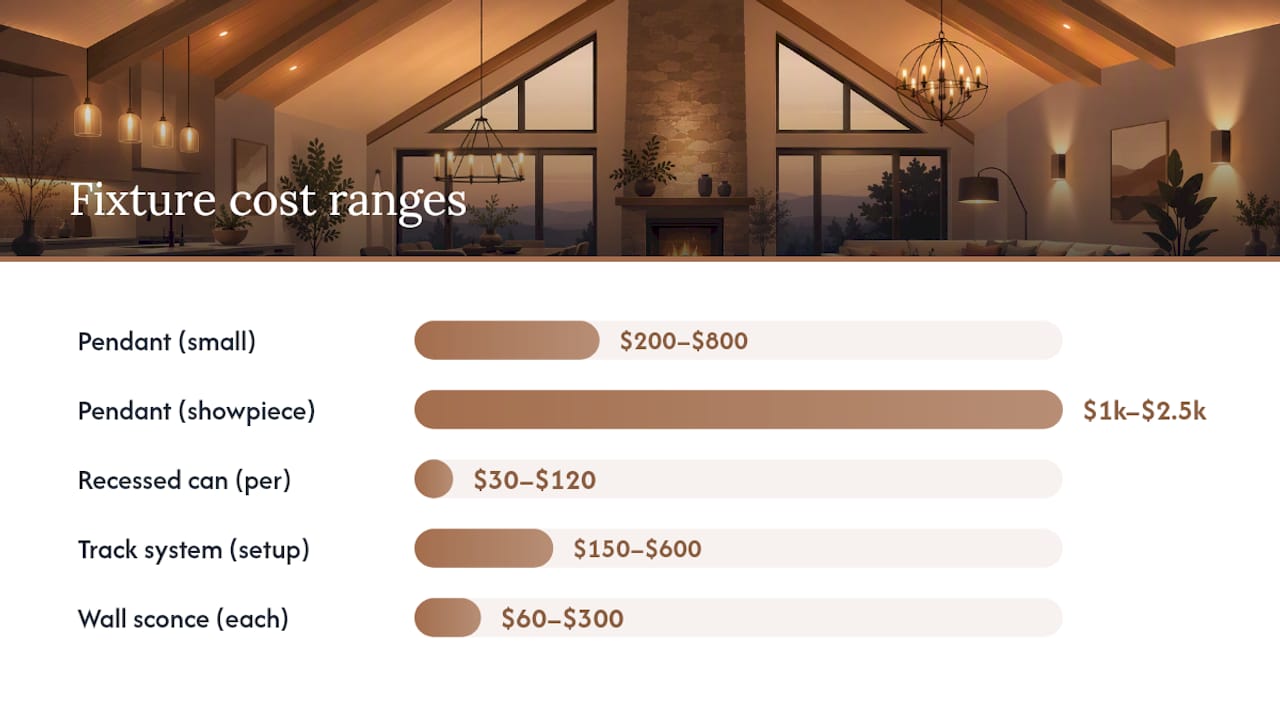
Total project cost depends heavily on ceiling height and how much electrical work is involved, but a few ranges help set expectations. A single statement pendant or small chandelier typically runs $200 to $800, while a larger showpiece for a great room can run $1,000 to $2,500 or more before installation.
Sloped-rated recessed fixtures cost $30 to $120 per can depending on trim style, and a typical living room needs four to eight of them. Track and magnetic track systems land between $150 and $600 for a full setup covering one wall or zone. Wall sconces run $60 to $300 each, and most rooms need two to four for even uplight coverage.
Installation labor is where vaulted ceilings add real cost compared to standard rooms. Electricians charge more for ladder or lift work, and a chandelier install requiring a lowering winch or reinforced structural mounting can add several hundred dollars beyond a standard fixture swap. Budget an extra 20% to 30% over a comparable standard-ceiling project if your existing wiring needs updating or if you're adding new switch locations for layered controls.
The smartest budget move is spending on the parts that are hard to change later. Sloped-rated housings and proper structural mounting points are worth paying for upfront since redoing them means opening drywall again.
Design Styles That Work With Vaulted Ceilings
Vaulted ceilings flatter more design styles than people expect, but each one calls for a slightly different fixture approach. Modern farmhouse rooms lean on oversized drum pendants or lantern-style chandeliers with black or aged brass finishes, paired with simple recessed cans for fill. Mid-century modern spaces favor sputnik or globe chandeliers with brass or walnut accents, kept minimal so the fixture itself becomes the sculpture.
Rustic or mountain-style rooms with exposed beams do well with wrought iron chandeliers and wall sconces that echo the beam material, since warm 2700K light plays beautifully against natural wood. Contemporary and minimalist interiors often skip the chandelier entirely in favor of magnetic track systems and linear LED coves, letting the ceiling's architecture speak without a heavy focal fixture.
Transitional style, which blends traditional shapes with cleaner lines, tends to split the difference: a simple drum or cage chandelier, sloped recessed lighting for fill, and sconces kept understated. Whatever direction you choose, color temperature consistency across fixtures matters more than matching every finish exactly. A room can mix black iron and brushed brass just fine as long as every bulb reads the same warmth.
Integrating Smart Controls With Vaulted Ceiling Fixtures
Smart lighting solves a problem specific to tall rooms: fixtures you can't easily reach shouldn't require reaching to adjust. Building scenes ahead of time means you're never climbing a ladder just to dim a chandelier for movie night.
Start with smart switches or in-wall dimmers rather than smart bulbs for any fixture that's hard to access, since a bulb failure at 18 feet up is far more annoying than a switch failure at eye level. Reserve smart bulbs for fixtures you can reach easily, like sconces or table lamps that round out the layered scheme.
Group fixtures by zone, not by fixture type, so your chandelier and matching sconces respond together as a single "seating area" group rather than as separate devices you adjust one by one.
Editorial Take: What the Scale Rules Don't Tell You
Most vaulted ceiling advice treats fixture sizing like a math problem: measure the room, apply the formula, order the chandelier. That gets you a fixture that fits the space, but it doesn't get you a room that feels good to sit in.
The overlooked variable is serviceability, and it's the one homeowners skip until year two when a bulb burns out 20 feet up and nobody wants to deal with it. A chandelier without a lowering plan isn't a design choice. It's a maintenance problem waiting to happen. The wall sconces that designers keep recommending for the "cave effect" aren't a nice-to-have accent either. They're doing structural work that recessed cans and pendants simply can't, because they're the only fixture type actually lighting the vertical plane instead of the horizontal one.
If you take one thing from measurement-driven advice like this, let it be sequencing: solve for access and layering before you fall in love with a fixture. The chandelier is the easy decision. Getting the room to feel warm at 9 p.m. on a Tuesday, dimmed low, is the harder one, and it's the one that actually matters most.
Let TheconnectedDwelling Help You Plan the Room, Not Just the Fixture
TheconnectedDwelling gives you what a single product page can't: a layered plan built around your actual room dimensions, not just a chandelier that looks good in a showroom photo. Instead of guessing at scale rules alone, you get curated fixture picks organized by the layering approach this article walks through, plus smart-control pairings that actually work together.

Start with the Lighting landing page for curated fixture recommendations across every category covered here, from sloped-rated recessed cans to statement pendants. If you want the full framework before you buy anything, The Beginner's Guide to Layered Lighting breaks down the ambient, task, and accent sequence in more depth than any single fixture spec sheet ever will. Browse the curated picks, bookmark the room recipe that matches your space, and start sketching your layout this week.
Sources
- Lighting a Vaulted Ceiling: A Step-by-Step Design Plan
- How to Light a Sloped or Vaulted Ceiling: 2026 Planning Guide – Seus Lighting
- Magnetic Track Lighting Solutions for Sloped and Vaulted Ceilings - LED Lights Direct
FAQ
What Type of Lighting Is Best for Vaulted Ceilings?
Layered lighting works best: a statement pendant or chandelier for scale, sloped-rated recessed or track fixtures for ambient fill, and wall sconces to uplight the angled walls. Designers consistently point to wall sconce uplighting as the single most effective tactic for avoiding a cold, cave-like feel.
How Do You Light a Vaulted Ceiling Without It Looking Empty?
Combine a scaled focal fixture with ambient recessed lighting and accent uplights on the walls, keeping everything within a warm 2700K to 3000K range. Grouping smaller pendants together rather than hanging one small fixture also helps the composition read as intentional rather than sparse.
What Type of Lighting Is Best for a Raked or Sloped Ceiling?
Sloped-rated recessed housings with swivel canopy adapters or magnetic track systems handle angled ceilings best, since standard fixtures won't aim correctly on a slope. Track systems in particular improve adjustability since you can reposition heads as your layout changes.
What Are Good Light Fixtures for Sloped Ceilings?
Sloped-rated recessed cans, magnetic track systems, pendant lights hung with swivel canopy hardware, and wall sconces all work well on sloped ceilings. The right mix depends on whether you need a focal point, flexible accent light, or general ambient fill, and most vaulted rooms benefit from using two or three of these types together.
How Much Does It Cost to Light a Vaulted Ceiling?
Costs vary by fixture count and how much electrical work is involved, but a full layered setup typically runs from several hundred dollars for a modest room to a few thousand for a larger great room with a statement chandelier. TheconnectedDwelling's Lighting page has current curated picks across a range of budgets if you want specific product options.