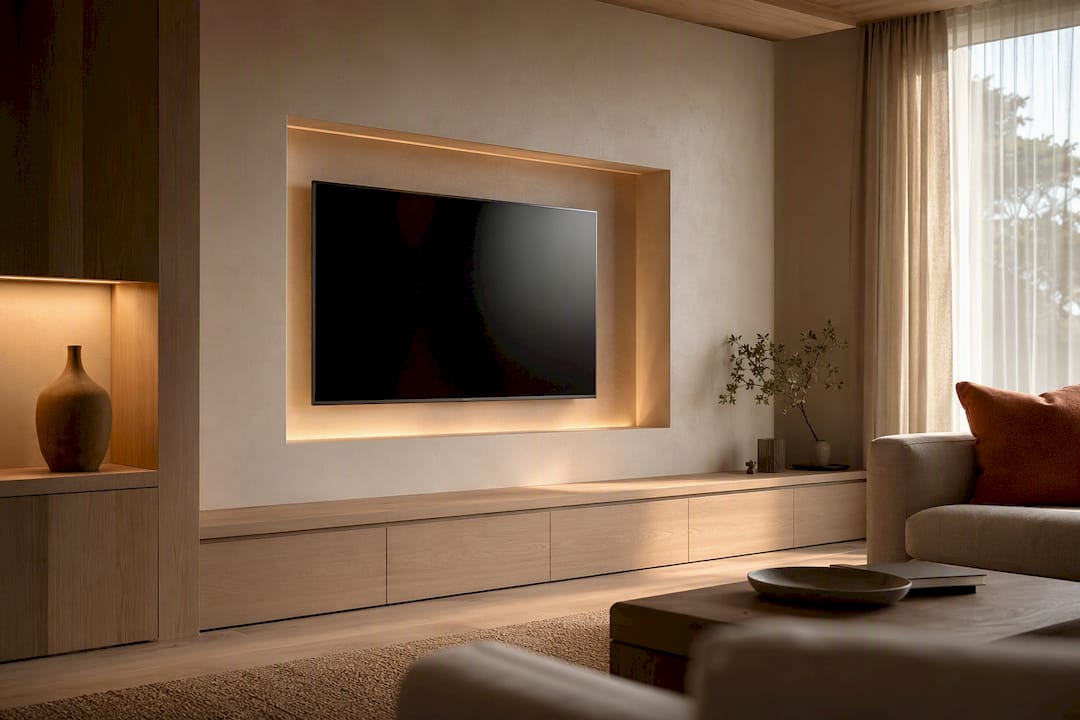
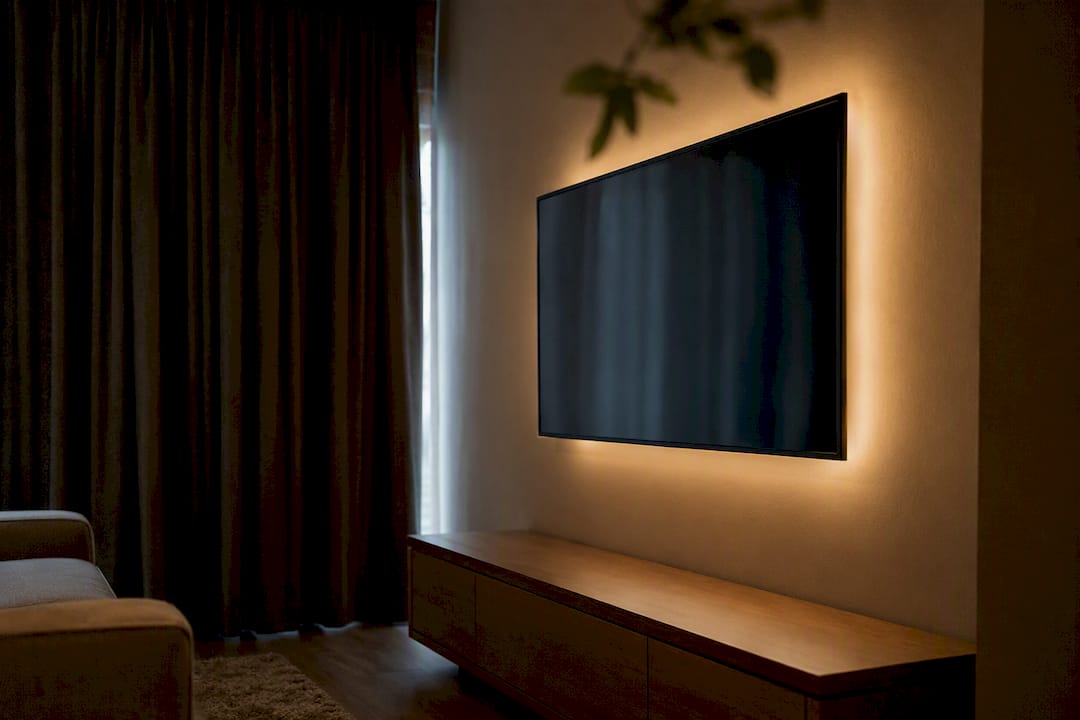
If you keep turning the television up to catch a sentence, then down again when the music starts, begin with the setup you already own. A soundbar buried in a console, a speaker firing into the side of a sofa, or a generous bass setting can make a capable system hard to live with.
The aim is clear speech at your normal evening volume and music that sounds balanced from the seats you use. That leaves plenty of room for curtains, a comfortable sofa and equipment that fits the furniture. You can work toward it one change at a time.
Find the problem before buying anything
Sit where you normally watch or listen. Choose a short passage you can repeat: a conversation without loud background music is useful for speech, and a familiar song with a distinct bass line helps with bass. Keep the volume comfortable and use the same passage after every adjustment. A louder version can seem more impressive, so avoid changing volume while comparing placement.
| What you hear | What to check first |
|---|---|
| Voices sound covered or distant | Obstructions in front of the speaker, the selected sound mode and dialogue controls |
| Bass is thick on some notes and weak on others | Subwoofer position and where you sit |
| Music seems to come from one side | Left/right balance, speaker spacing and unequal distances to the seat |
| Speech sounds splashy in a bare room | Reflections from glass, hard floors and nearby walls |
| Voices have an echo | Whether the TV and external speakers are both playing |
| Explosions are too loud at a useful dialogue volume | Night mode or dynamic-range compression |
Try a second program before deciding the equipment is at fault. If ordinary news speech is clear and one film is difficult, the soundtrack or its selected audio track deserves attention. You may still prefer a dialogue setting for that film, but replacing every speaker would be an expensive first response.
Make room for the sound to reach you
Look at the system from your seat. Can you see the speaker fronts, or are they behind the television, a cabinet door, a stack of books or a tall vase? Dolby’s setup guidance recommends a clear path between speakers and listeners. Start by clearing that path.
If you have a soundbar
Center it on the television and keep its grille exposed. Follow the model’s placement instructions: some bars also have speakers on their sides or top, and putting those inside a furniture cubby obstructs their output. The television should remain at a comfortable viewing height; check soundbar clearance before committing to a new console or mount.
For example, the Sonos Arc guide has model-specific placement and mounting instructions. Use the equivalent guide for your own bar rather than assuming one clearance measurement applies to every design.
Move ornaments beside the equipment instead of in front of it. If the console has a solid door, an attractive closed cabinet is usually a better place for spare cables than for the speaker itself. Leave ventilation and connector access as the manufacturer specifies.
If you have a pair of speakers
Choose one main listening seat for the initial setup. Give the left and right speakers similar distances to it, and aim for similar surroundings on each side. A speaker beside a large window and another tucked into a corner will interact with the room differently.
For conventional stereo speakers, start with a roughly equal-sided triangle between the two speakers and your seat, with their tweeters near seated ear height. Genelec’s placement guide uses this geometry for stereo monitoring. It is a useful starting point in a living room; the manufacturer’s instructions and your listening check decide the final position.
Angle the speakers inward a little if the voice in a familiar recording seems vague or pulled to one side. Compare from the sofa’s other seats too. A setup optimized for one chair can be less convincing when someone sits at the end of a wide sofa.
Use stable stands or furniture that supports the speakers securely. Do not perch them on improvised stacks to reach the right height. Mark a promising position with removable tape so you can return to it after trying another arrangement.
If you have one wireless speaker
Start on an open surface near the area where you listen, with room around its grille. Follow its orientation instructions. A single speaker can suit background music, but it cannot give the same separation as a properly spaced stereo pair. Before buying a second one, check whether the exact models support stereo pairing; playing the same music on two grouped speakers may be a different mode.
Clearer TV dialogue starts with the settings
Photograph your current settings before changing them. Begin with the standard sound mode and turn off optional bass boosts or exaggerated surround effects while you establish a baseline. Menu names vary, so change one setting, repeat your passage and decide whether it helps.
Check the TV’s selected audio output. It should send sound to the system you intend to use. Unless the manufacturer provides a coordinated feature specifically designed to combine them, avoid having the TV’s own speakers and external speakers playing together. Their timing can differ and create an echo.
If your equipment has a dialogue or speech control, try its lowest useful setting. Sonos describes Speech Enhancement as boosting frequencies associated with the human voice. Other systems use different processing, and stronger is not always more natural. Compare both an ordinary voice and a busy scene before keeping the change.
For late viewing, look for night mode, reduce loud sounds or dynamic-range compression. This brings loud and quiet passages closer together. Sonos Night Sound, for instance, reduces loud sounds and raises quieter ones. It can make a film easier to follow at low volume, though you may prefer to switch it off for daytime viewing.
With an AV receiver and a separate center speaker, verify that the center channel is enabled, unobstructed and calibrated. Adjust its level modestly if needed. Turning up the subwoofer or rear speakers will not solve a quiet center channel.
Use the right TV connection
Before buying a soundbar or powered stereo pair for television, inspect the TV’s actual ports. An HDMI socket labeled ARC or eARC sends TV audio to compatible audio equipment. Connect the system to that labeled port and follow both devices’ setup instructions.
HDMI’s eARC documentation explains that eARC supports higher-bandwidth audio formats than ARC. That is a compatibility consideration, not a promise that an eARC label alone will make dialogue clearer. The TV, audio system and selected format all need to work together.
Optical can be a sensible connection for an older television when the audio system supports it. Check the supported formats and how you will control volume. A Bluetooth-only speaker may introduce noticeable delay with television; Sony’s Bluetooth troubleshooting guidance describes this issue. Choose a supported wired TV connection when reliable synchronization matters.
If lips and voices are out of sync, compare a built-in TV app with any external streaming box. Then consult the audio-delay instructions for the affected devices. Sonos’s sync guidance separates early from late audio: adding audio delay helps only when sound arrives too early. Photograph the original value and avoid changing the TV, streamer and soundbar delay controls together.
Soften reflections with things the room already needs
Large panes of glass and bare floors can make a room sound lively. Genelec’s room-acoustics guidance distinguishes reflective hard surfaces from absorbing materials such as sofas, heavy curtains and thick carpets. That gives you useful choices which also belong in a living room.
If you have been planning a rug, try it across the exposed floor between the speakers and sofa. Close existing lined curtains for a listening comparison. An upholstered chair can make more sense beside the listening area than another hard decorative surface.
Make one change and replay your speech passage. A clap can reveal an obvious ringing echo, but it does not tell you whether bass is balanced or every word will be intelligible. Your seated listening check matters more.
Fabric mainly helps with higher-frequency reflections. A normal rug or curtain is not a dependable cure for deep bass peaks, and it does not soundproof the room for the neighbors. Books and uneven surfaces can scatter some sound, but a bookcase is not a substitute for measured acoustic treatment.
Start with furnishings you want to live with. If the room remains difficult, fabric-covered acoustic panels can be chosen as deliberate wall elements. Severe bass problems need a different approach: placement first, then measurements or specialist advice if simple changes fail.
Give bass its own listening test
If every bass note seems to have the same swollen character, reduce the subwoofer level temporarily and compare several seats. A spot that sounds forceful by a wall can sound thin elsewhere. Room reflections can create peaks and cancellations, so the neatest empty corner is not automatically the best location.
Try the practical floor positions you can accommodate. Keep the same song and volume, and judge whether you can follow separate notes rather than picking the spot with the most rumble. Moving your listening position can help too. Test by sitting a little forward before deciding to move the whole sofa.
If your subwoofer is a conventional movable model, the SVS subwoofer crawl offers a more systematic comparison:
- Place the subwoofer safely at or near the main listening position. Get help with a heavy unit.
- Play a familiar repeating bass passage at a comfortable level.
- Listen from the floor positions where the subwoofer could realistically live.
- Choose the spot where notes sound most even, move the subwoofer there and check again from the sofa.
For proprietary soundbar subs, follow the system’s placement and tuning instructions. Once the location is settled, rerun any supported room calibration and adjust the level. Keep ports, vents and access clear; hiding a subwoofer inside a closed cabinet can introduce rattles and restrict placement.
Our subwoofer placement guide goes further into bass measurement if you want to investigate a persistent problem.
Choose the smallest system that solves your problem
A good purchase starts with where equipment can go and how you will use it. Measure the available surface and check nearby power before comparing model names.
| Your main use | A sensible starting point | Check before buying |
|---|---|---|
| TV and films with minimal equipment | A soundbar | TV connection, dialogue controls, physical clearance and remote behavior |
| Music from a regular seat | A stereo pair | Useful spacing, stands or stable surfaces, and your preferred music input |
| Music and TV from one system | Powered stereo speakers with a supported TV input, or passive speakers with an appropriate amplifier | Volume control, TV compatibility and space for the complete setup |
| Clear fronts, but not enough low bass | A compatible subwoofer added to the existing system | System compatibility and a usable floor position |
| Films with sound around the seats | A surround system | Real locations and power or cable routes for the rear speakers |
Powered speakers contain amplification. Passive speakers need a separate amplifier or receiver. Include that equipment, stands, cables and any required accessories in the total, along with the space they occupy.
Surround and height features are worth paying for when you can place the equipment properly and the content supports them. If your main frustration is missing dialogue during ordinary TV, evaluate that first in a demonstration or during the return period. Bring a familiar clip and listen at the volume you use at home.
For a clean installation, choose the cable route before the final equipment position. Our guide to hiding speaker wires covers ways to keep the room tidy. The companion guide to making a TV look better in the living room helps with the composition around the screen.
A listening plan for one afternoon
Work through this in order, stopping when the original problem is resolved:
- Photograph the settings and choose the speech passage and music track you will use for comparisons.
- Clear the speaker fronts. Check the selected TV output and any duplicate playback.
- Improve the existing placement: open up a soundbar’s surroundings or balance the distances of a stereo pair.
- Try dialogue enhancement or night mode if speech is still difficult at your normal volume.
- Compare with curtains closed or an existing rug in the listening area.
- If bass remains uneven, test another subwoofer location before raising its level.
- Run supported calibration after the layout is settled, then check the other seats.
Write down what still bothers you before spending money: “voices are clear but bass is missing” is a useful buying brief; “the system needs to be better” is not. Keep the successful placement marks until you have lived with the result for a few evenings.