
Start with your subwoofer in the front half of the room, close to your main speakers, then confirm the spot with a subwoofer crawl or a real measurement. That's the whole strategy in one line. Bass response is so sensitive to position that moving the box a few inches can change what you hear at your couch, so treat any rule of thumb as a starting guess, not a final answer.
TL;DR:
- Subwoofer placement should start near the front of the room, ideally about a third or one-fifth of the way in, to avoid standing-wave zones.
- The subwoofer crawl is an effective method to identify the best spot by listening for tight, even bass at the listening position, then confirming with measurement.
- Room modes cause uneven bass response and are most problematic near walls and corners, which can amplify or nullify certain frequencies.
- Measuring with room EQ software like REW provides precise confirmation, as even inches of movement can significantly alter the bass response.
- Placement for multiple or small rooms often involves strategic positioning of two subwoofers and accepting practical constraints for optimal sound.
Table of Contents
- What's the Best Starting Point for Subwoofer Placement in a Room?
- How Do You Do a Subwoofer Crawl to Find the Best Spot?
- Why Do Room Modes Change Everything About Placement?
- How Should the Subwoofer Blend With Your Main Speakers?
- What Should You Do in a Small Room or With Multiple Subs?
- How Do Furniture and Floors Affect Where You Should Put the Sub?
- How Do You Measure and Confirm Subwoofer Placement?
- Does Carpet or Hardwood Flooring Change Subwoofer Bass?
- Does It Matter if Your Subwoofer Is Ported or Sealed?
- Does Your Seating Position Change Where the Subwoofer Should Go?
- A Designer's Note on Balancing Bass and Living-Room Style
- Help is available for the parts of a living room that measurement alone can't fix: how the furniture, lighting, and layout around your subwoofer actually feel to live with. Placement solves the acoustics; design solves whether that spot works with the rest of the room you've built.
- Sources
- FAQ
What's the Best Starting Point for Subwoofer Placement in a Room?
The two most repeated rules in subwoofer placement room design are the rule of thirds and the one-fifth rule. Both give you a defensible starting point instead of a guess pulled from thin air. The rule of thirds has you place the sub roughly a third of the way into the room from the front wall; the one-fifth rule nudges that slightly closer to the wall. Either one tends to land you outside the worst standing-wave zones that plague a rectangular room, and Polk's placement guidance treats this as the default first move for exactly that reason.
Corners and walls are a different story. Pushing a subwoofer into a corner increases output through boundary reinforcement, which sounds great on paper and often turns muddy in practice. That's because the same boost that adds volume also adds boominess at specific frequencies.
- Small or underpowered subs often benefit from corner loading because they need the extra gain.
- Larger, well-powered subs frequently sound tighter and more even pulled 8 to 12 inches off the wall, based on testing from Digital Trends.
- Placing the sub near your front speakers usually improves timing, since sound from both sources reaches your ears at closer to the same moment.
None of these are guarantees. They're just better odds than picking a spot because it's convenient for your furniture.
How Do You Do a Subwoofer Crawl to Find the Best Spot?
The subwoofer crawl remains the single best no-equipment test you can run, and it works because of a principle called acoustic reciprocity: the response measured at point A from a source at point B equals the response at point B from a source at point A, according to research on the crawl method. In plain terms, the bass at your listening seat will sound the same whether the sub is there or you are.
Here's how to run it:
- Move the subwoofer to your main listening position, the exact spot where your head sits when you watch or listen.
- Play bass-heavy music, a movie scene with sustained low end, or pink noise on a loop.
- Get down on the floor and crawl slowly around the room's perimeter and open floor space, listening for where the bass sounds tightest and most even rather than loudest.
- Mark two or three candidate spots with tape once you notice a clear improvement.
- Move the subwoofer back to its normal position and place it at each marked spot in turn, listening from your actual seat to confirm which one holds up.
Digital Trends points out this is exactly why the crawl works as a practical, ear-based test rather than a gimmick. Its limitation is your own hearing. Low bass is hard to localize and easy to misjudge, especially below 40 Hz, so treat the crawl as a shortlist generator. The final call belongs to measurement, which we'll get to shortly.
Why Do Room Modes Change Everything About Placement?
Every rectangular room has axial modes, standing waves that form between two parallel surfaces like your front and back walls. These modes create pressure peaks (antinodes) near boundaries and pressure zeros (nodes) at specific points in between, and where your subwoofer sits determines which modes it excites and how strongly.
That's the physics behind a frustrating pattern many homeowners notice without knowing why: one note booms while the note next to it disappears. If your bass changes noticeably when you tilt your head a few inches, you're likely sitting near a modal node, and no amount of EQ will fully fix a physical seating problem.
Corner placement tends to excite more modes at once because a corner sits at the intersection of three boundary planes, according to GIK Acoustics' analysis of subwoofer placement. That's the tradeoff behind the reinforcement you get from a corner. More output, but also more unevenness across frequencies.
Signs your placement is fighting room modes:
- Bass that sounds like a single droning note instead of distinct pitches.
- Response that shifts dramatically when you move your head just a few inches.
- One frequency that rattles windows while a nearby frequency barely registers.
Non-rectangular rooms complicate this further. Modal analysis on L-shaped or angled rooms shows that corners are not interchangeable; measured output can vary substantially between corners that look symmetrical on a floor plan but behave very differently acoustically.
How Should the Subwoofer Blend With Your Main Speakers?
Getting placement right solves half the problem. The other half is timing. Bass frequencies travel slowly enough that distance actually matters. At low frequencies, a subwoofer positioned more than half a wavelength farther from your seat than your main speakers can arrive close to 180 degrees out of phase, according to KEF's explanation of phase and positioning. That mismatch cancels bass instead of reinforcing it.
A few practical checks fix most integration problems:
- Start your crossover at 80 Hz, the standard handoff point for most home theater setups, then nudge it up or down while listening for a seamless blend rather than a gap or overlap.
- Flip your subwoofer's phase switch (0 or 180 degrees) and listen for which setting produces fuller, tighter bass at your seat.
- Walk around the room while a mono bass track plays. If you can pinpoint the subwoofer's location by ear, it's likely too loud, poorly integrated, or crossed over too high.
- Listen specifically for a "hole" in the midbass around 60 to 100 Hz, a common symptom of phase cancellation between the sub and mains.
Small phase adjustments often matter more than people expect, especially once the subwoofer sits more than a few feet from the main speakers.
What Should You Do in a Small Room or With Multiple Subs?
Small rooms limit your options fast. Front-wall placement, even near a corner, is sometimes the only realistic choice once you account for doorways, media furniture, and seating. That's not a failure. It's a constraint you work around with the tools you have.
- In a tight room, try both front corners as candidate spots during your crawl, since one will almost always outperform the other.
- If a single sub leaves a persistent dead zone at your seat, a second subwoofer placed at a complementary position is usually more effective than endlessly repositioning one unit.
- Two subs placed symmetrically, one on each side of the front wall, significantly reduce seat-to-seat variance and produce flatter response across multiple listening spots, based on GIK Acoustics' research.
- The tradeoff is cost, floor space, and a slightly more complex calibration process, so weigh that against how many people actually sit in the room at once.
How Do Furniture and Floors Affect Where You Should Put the Sub?
Bass doesn't care about your décor, but your décor changes how bass behaves. Rugs, upholstered furniture, and bookshelves absorb some higher bass frequencies and break up flat reflective surfaces, which can soften harsh peaks without a single acoustic panel in sight. A heavy media console pressed against the front wall can also work like an accidental bass trap.

Isolation pads or spikes under the subwoofer matter most on suspended wooden floors or upper-level rooms, where vibration transfers to the structure below. On a slab foundation, they do far less.
Pro Tip: Instead of foam panels in a corner, try a floor-to-ceiling bookshelf loaded unevenly with books and objects. It breaks up reflections almost as effectively and looks intentional rather than accidental.
For more ideas on arranging furniture without sacrificing style, TheconnectedDwelling's warm modern living room recipe shows how layout choices double as acoustic ones.
How Do You Measure and Confirm Subwoofer Placement?
Your ears get you close. Measurement gets you right. The standard toolkit is Room EQ Wizard (REW), a free program, paired with a calibrated microphone like the UMIK-1, run in as quiet a room as you can manage.
- Set up REW with your calibrated mic at your primary listening seat.
- Run a frequency sweep at each candidate position you marked during the crawl.
- Overlay the resulting curves in REW so you can compare them directly rather than relying on memory.
- Pick the flattest curve between roughly 40 and 120 Hz, not the loudest one. Practitioners consistently find that the loudest spot is usually the wrong one, since it's boosting a narrow peak rather than delivering even output.
- If every position still shows a deep null below 80 Hz, that's your cue to add a second subwoofer or targeted bass trapping rather than keep chasing a single-sub fix.
Moving a subwoofer even an inch or two can shift the measured response at your seat by a meaningful margin, based on RealTraps' analysis of placement sensitivity. That's the entire argument for measuring instead of eyeballing it.
Does Carpet or Hardwood Flooring Change Subwoofer Bass?
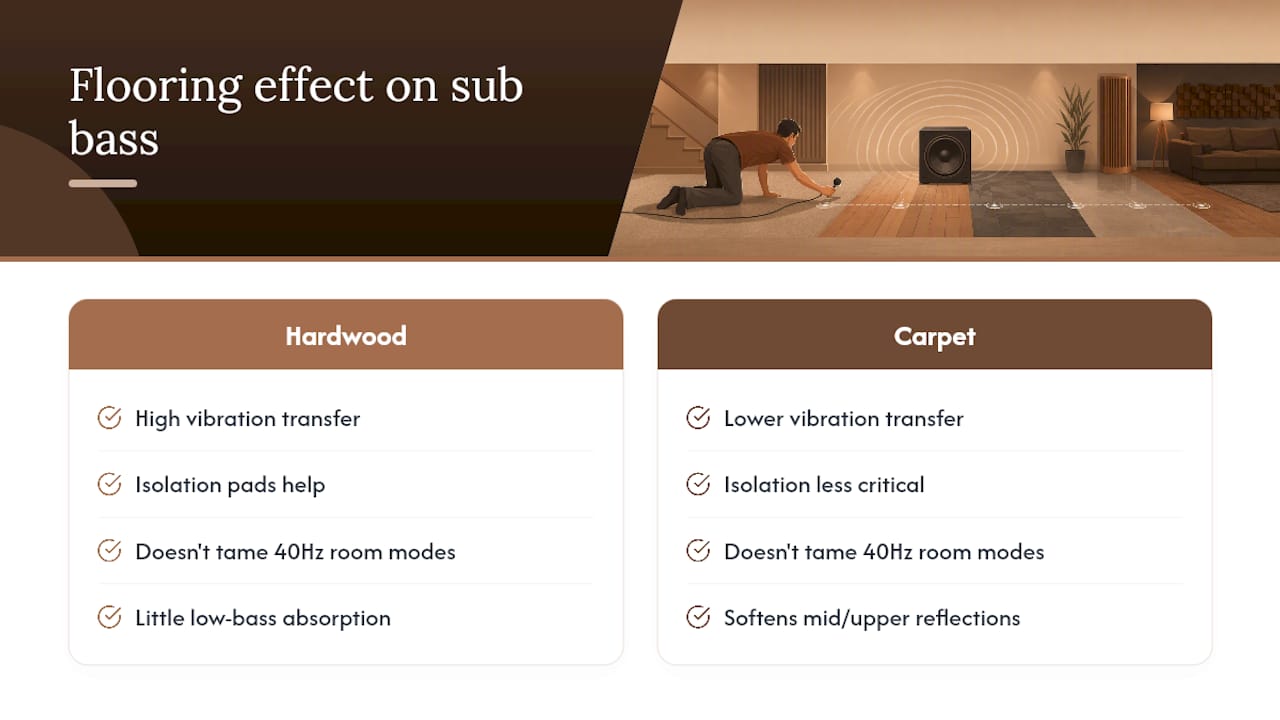
Flooring has a smaller effect on bass than most people assume, but it's not zero. Bass wavelengths are enormous, several feet to tens of feet long, so a thin layer of carpet or padding doesn't absorb low frequencies the way it absorbs higher ones. What flooring does influence is coupling and vibration transfer.
Hardwood and other hard, rigid floors transmit vibration efficiently through the structure of the house. That's the scenario where isolation pads or a dense platform under the subwoofer actually help, both for sound quality and for reducing structure-borne noise that travels to rooms below. If you live above another unit or share a floor with bedrooms, that vibration transfer is often the real complaint, not the airborne bass itself. Interior door upgrades can help contain that noise as it travels through a home, and options built for reducing structure-borne sound are worth a look if a downstairs room shares a wall or ceiling with your listening space.
Carpet over a hard subfloor softens footfall noise and some mid and upper bass reflections, but it won't meaningfully tame a 40 Hz room mode. Don't expect a rug to fix a placement problem. Expect it to make the room feel calmer and slightly less bright, which is a real benefit, just not an acoustic cure for bad positioning.
Does It Matter if Your Subwoofer Is Ported or Sealed?
Yes, and the difference shapes where placement problems show up. A sealed subwoofer produces a tighter, more linear low-frequency rolloff, which generally makes it more forgiving of placement because it has less inherent boom to interact badly with room modes. A ported subwoofer produces more output for the same amplifier power, often with deeper extension, but that extra output comes with a resonant peak near the tuning frequency of the port. That peak can compound with a room mode at a similar frequency and turn a mild boom into an obvious one.
This matters directly for corner placement. A ported sub pushed into a corner stacks boundary reinforcement on top of its own port resonance, which is a common reason ported subs sound "one note" when corner loaded. A sealed sub in the same corner still gets a boost, but it's a gentler, broader one that's easier to tame with crossover and phase adjustments.
If you're choosing between the two for a room you already know is acoustically difficult, a sealed design gives you more placement flexibility. If you have the room to experiment and want maximum output for movies, a ported design rewards a careful subwoofer crawl and measurement pass, since its performance swings more dramatically between good and bad positions.
Does Your Seating Position Change Where the Subwoofer Should Go?
Placement and seating are the same decision, not two separate ones. The subwoofer crawl works precisely because you're testing bass response from the seat you'll actually use, not some average point in the room. If you move your couch after finalizing subwoofer position, you've effectively changed the test.
A center seat in a symmetrical room tends to sit closer to a modal node for certain frequencies than an off-center seat does, which is part of why couples on opposite ends of a sectional sofa sometimes disagree about how "boomy" the bass sounds. They're not imagining it. They're sitting in genuinely different acoustic zones.
If your seating is fixed, such as a sectional against a specific wall, run your crawl and measurement from every seat people actually use, not just the primary one. A single subwoofer optimized for one chair can leave a null at the seat three feet to the left. This is the practical case for a second subwoofer in rooms with wide or multiple seating areas: it's not about raw output, it's about giving every seat a fighting chance at even bass.
A Designer's Note on Balancing Bass and Living-Room Style
Good bass and good design aren't in competition, whatever your first instinct says when you're staring at a subwoofer-shaped box next to your sofa. I'd rather see a slightly imperfect placement that still looks like part of the room than a technically perfect corner jammed with foam. Measure, adjust, and accept that your living room will always be a compromise between the two, worked out one small move at a time.
Help is available for the parts of a living room that measurement alone can't fix: how the furniture, lighting, and layout around your subwoofer actually feel to live with. Placement solves the acoustics; design solves whether that spot works with the rest of the room you've built.

If your subwoofer crawl keeps landing you near a bare corner or an awkward stretch of wall, our beginner's guide to better living-room sound walks through pairing acoustic decisions with the rest of your room's design. For the layering and fixtures that make a room feel finished once the sound is sorted, our beginner's guide to layered lighting is a natural next stop. Start there, and you'll end up with a room that sounds right and looks like you meant it.
Sources
For deeper technical detail, GIK Acoustics' guide to subwoofer placement and RealTraps' analysis of placement sensitivity both cover modal behavior and measurement in more depth.
- How to set up a subwoofer for best room position and sound - Digital Trends
- 5 Tips for Perfect Subwoofer Placement | Polklore
- Room setup: Speaker placement part two — subwoofers | GIK Acoustics
FAQ
What Is the 83% Rule for Speaker Placement?
The 83% rule refers to seating distance for surround speakers relative to screen size, not subwoofer placement; for subs, the rule of thirds or one-fifth guideline provides a defensible starting point.
What Are Common Subwoofer Placement Mistakes?
The most common mistakes are jamming the sub into a corner without testing alternatives, skipping the subwoofer crawl entirely, and judging placement by loudness instead of evenness across frequencies.
Do Subwoofers Bother Downstairs Neighbors?
Low frequencies travel efficiently through floors and walls, especially on suspended wood construction, so isolation pads, careful placement away from shared walls, and noise-reducing doors can all help reduce disturbance.
Is It Better to Have a Subwoofer on the Floor or Elevated?
Floor placement is standard and usually correct, since it takes advantage of boundary reinforcement; elevating a subwoofer rarely helps unless it solves a specific line-of-sight or furniture obstruction and should still be confirmed with a crawl or measurement.