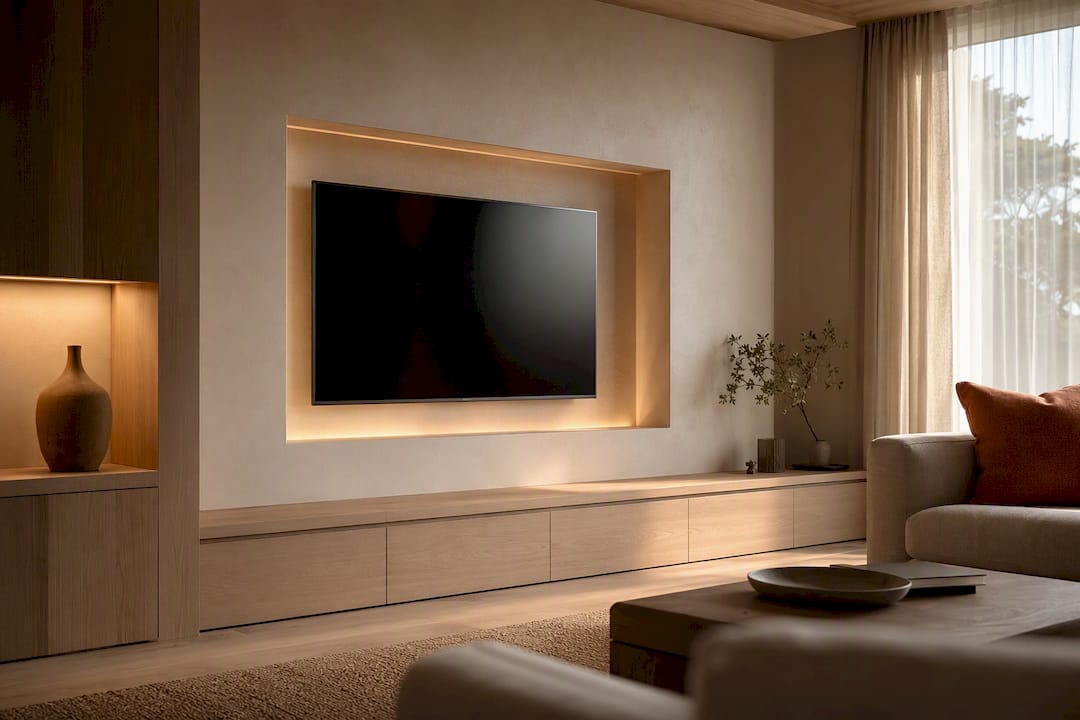
TV glare is a geometry problem before it is a television problem. A bright window or bare bulb hits the screen and reflects toward your seat. Increasing screen brightness may make the picture easier to see, but it does not remove the reflection.
Begin with the screen off. Sit where you normally watch and look at the black panel. The window, doorway or lamp you can see reflected there is the first thing to change.
Fix glare in this order
- Control the offending window or lamp.
- Change the relationship between the screen, light source and seat.
- Use the television’s ambient-light and picture controls.
- Add bias lighting for dark-room comfort, not as a cure for daytime reflections.
- Consider a film, protector or new television only after the room-level fixes fail.
This order starts with changes that are inexpensive, reversible and least likely to reduce picture quality.
Start with the window you can see in the screen
A television directly opposite a large window has the hardest job. If the room layout allows it, place the screen on a wall perpendicular to the window rather than facing it. Samsung’s placement guidance similarly recommends avoiding a screen directly opposite a strong light source.
When the television cannot move, treat the specific window rather than darkening the entire room by default.
For flexible daytime control
- Adjustable blinds or shades let you redirect light while preserving some daylight.
- Lined curtains soften a bright window and add useful acoustic absorption.
- Blackout shades provide the strongest control for daytime films, but they make the room feel closed when fully drawn. Choose them when darkness is genuinely part of the viewing goal.
Light-filtering fabric reduces brightness but may remain a glowing rectangle in a glossy screen. If the window is directly opposite the TV, test a sample at the time of day when glare is worst.
Move or soften reflected lamps
At night, one exposed bulb can be more distracting than a whole softly lit room. With the TV off, turn lamps on one at a time. Move any lamp that appears in the screen from the main seat.
Useful changes include:
- shifting the lamp farther to the side of the television;
- lowering it so the shade blocks the bulb;
- turning the opening of a directional lamp away from the screen;
- replacing a clear bulb with a diffused bulb inside a suitable fixture; and
- bouncing light onto a wall instead of aiming it into the room.
You do not need to watch in darkness. You need light whose bright source is not mirrored back at you.
Change the angle only after a small test
There is no universal five-, ten- or fifteen-degree cure. The useful angle depends on the window, screen coating, mount, seat height and viewing-angle performance of the television.
Before buying a mount, temporarily change one variable. Move the seat a little, rotate a TV that sits on a console, or hold a mirror against the dark screen to understand the reflection path. If a small horizontal rotation moves the reflection away from every important seat, a swivel mount may help.
Tilting a wall-mounted television downward can redirect some reflections, but it can introduce a ceiling or lamp reflection and make the picture less consistent from other seats. Use only the adjustment range supported by the TV and mount manufacturers, confirm the VESA pattern and weight rating, and do not improvise spacers or mounting hardware.
Check picture settings without chasing maximum brightness
Many current televisions include a light sensor or an automatic luminance setting. Sony describes these controls as adjusting screen brightness for the room and reducing glare. The name and behavior vary, so consult the manual for the exact model.
Try this sequence:
- Choose the most accurate normal picture preset you enjoy.
- Turn on the ambient-light sensor and watch familiar content.
- If the daytime picture remains washed out, increase the panel-light or brightness control modestly.
- Avoid changing many contrast, gamma and black-level controls at once.
- Save separate day and evening presets if the television supports them.
More brightness can improve visibility in a bright room, but it may use more energy and feel tiring at night. The room-level reflection still deserves attention.
What bias lighting actually does
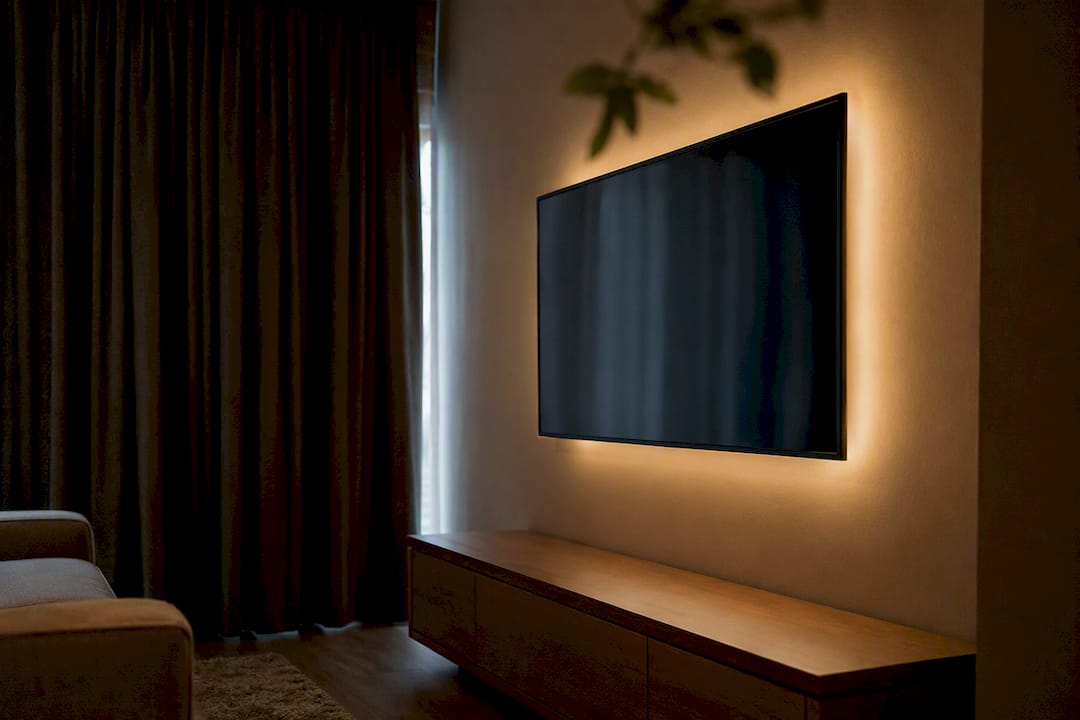
Bias lighting is a soft light placed behind the television so it illuminates the wall around the screen. It can make evening viewing feel less stark by reducing the apparent contrast between a bright picture and a dark room.
It does not cancel a window reflected on the screen. Treat it as an evening-comfort layer.
For casual living-room use, choose a dimmable white strip with even diffusion. Neutral white avoids adding an obvious color cast around the picture; warmer light can feel more at home in the room but is less suitable when color-critical viewing matters. Keep the strip itself hidden and avoid visible dots on the wall.
Place nearby lamps so they light the wall or room without appearing in the panel. The broader principles in why living-room lighting feels wrong apply particularly well around a large bright screen.
Should you use an anti-glare film or screen protector?
Treat an add-on film or acrylic protector as a last resort. A matte surface spreads reflections, which can make their shape less obvious, but it can also reduce perceived sharpness or contrast. Fit, installation dust and cleaning become additional problems on a large screen.
Use one when the television cannot move, the window cannot be treated and protection is valuable for another reason. Check that the maker supports the exact screen size and display type, and understand the return policy before applying an adhesive product.
Do not apply household cleaners, films or coatings directly to a television unless the TV manufacturer permits them.
When a different television makes sense
If the room must remain bright and the existing screen is persistently mirror-like, reflection handling and sustained brightness belong on the replacement checklist. Compare independent measurements for the exact model; marketing terms such as “anti-glare” are not standardized descriptions of identical performance.
A replacement should still follow the room fixes. Even a capable bright-room television will struggle with the image of a sunny window placed directly behind the viewer.
A low-cost glare plan
Try this before buying a mount or screen accessory:
- Turn the TV off during the problem hour and photograph the reflection from the main seat.
- Cover only the reflected window with a temporary opaque cloth.
- If the glare disappears, buy an adjustable treatment for that window.
- At night, repeat the test with each lamp.
- Enable the TV’s ambient-light control and create separate day and evening presets.
- Add dim bias lighting only if evening viewing still feels severe.
The best result often leaves the room looking almost unchanged. The window still supplies daylight, the lamps still make the living room comfortable and the screen no longer reflects the brightest object directly toward the sofa.