The best foyer lighting pairs a fixture sized correctly for your space with layered light and warm, dimmable bulbs. Start with a chandelier, pendant, or flush mount scaled to your room, then add a sconce or table lamp for warmth, and finish with 2700K to 3000K LED bulbs. Everything else in this guide fills in the details.
TL;DR:
- Use layered lighting with a properly scaled overhead fixture plus sconces or table lamps, all with dimmable warm bulbs in 2700K to 3000K for a welcoming feel.
- Measure your room's dimensions and ceiling height carefully, ensuring at least 7 feet clearance from the fixture bottom and proportional placement for two-story foyers.
- Incorporate accent and task lighting, such as puck lights or mirror-mounted sconces, to add depth and functionality without extensive wiring.
- Choose warm metals like brass or aged finishes for versatility, and use mirrors or reflective surfaces to maximize natural and artificial light.
- Opt for energy-efficient LED bulbs with high CRI and install motion sensors or smart controls to enhance convenience and reduce energy waste.
Table of Contents
- Foyer Lighting Ideas by Fixture Type
- Foyer Chandelier Size Guide and Placement Rules
- Layered Lighting: The Real Secret to a Warm Foyer
- Choosing Finishes for Your Foyer Fixtures
- Bulb Choice and Smart Controls for Foyer Lighting
- Entryway Lighting Solutions for Small or Narrow Spaces
- How Foyer Function Should Shape Your Lighting Plan
- Maintenance Tips for Foyer Fixtures
- Energy Efficiency in Foyer Lighting
- Safety Considerations for Foyer Lighting Placement
- Using Natural Light and Reflective Surfaces in Your Foyer
- Our Take on Foyer Lighting Priorities
- Find Your Fixture: Curated Foyer Lighting Resources
- Sources
- FAQ
Foyer Lighting Ideas by Fixture Type
Your ceiling height and floor plan should decide the fixture, not the other way around. Here's how the main categories break down.
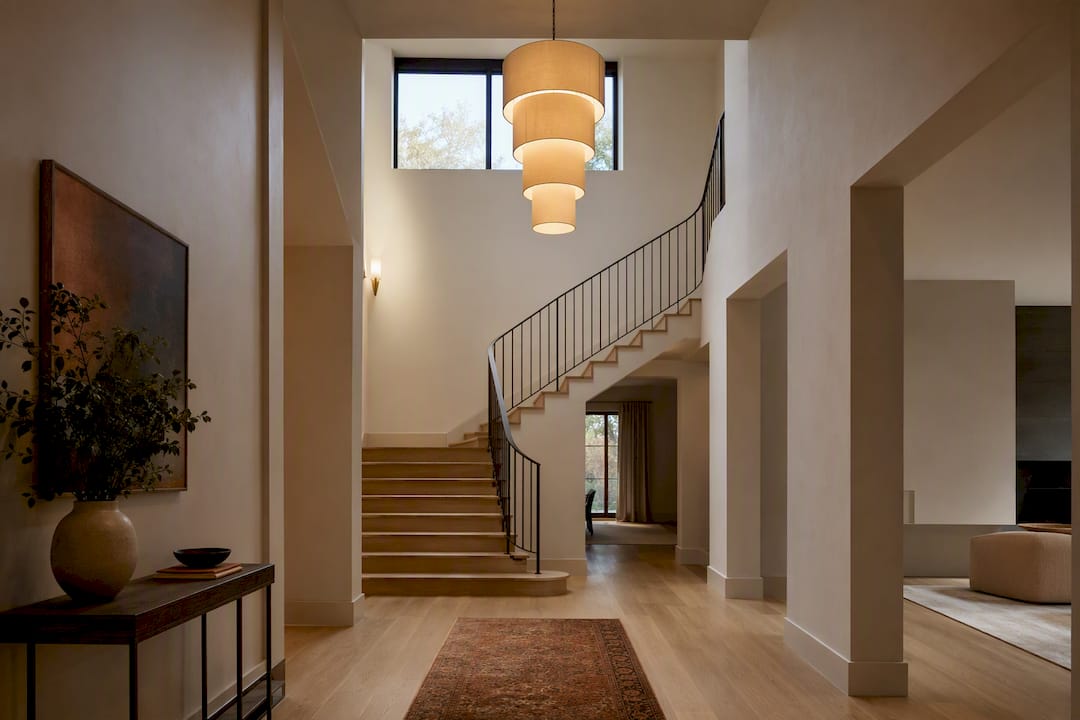
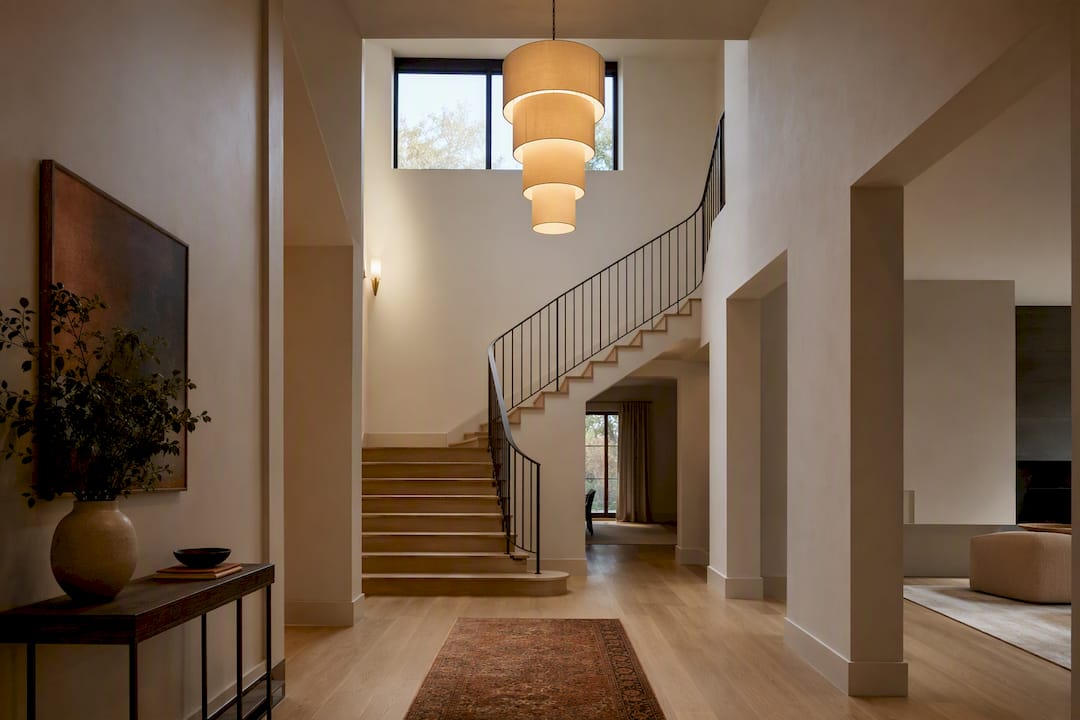
Chandeliers work best with ceilings over 9 feet, especially in two-story foyers where a fixture can hang without crowding the walkway. Tiered or clustered designs (multiple small pendants grouped together instead of one large shade) read as more current than a single traditional chandelier, and they scale beautifully in tall entries.
Pendants suit standard 8 to 9 foot ceilings and narrower entries where a chandelier would feel oversized. A single statement pendant with a visible bulb and warm filament reads as intentional, but only if the finish coordinates with the rest of your hardware.
Semi-flush and flush mounts are the answer for anything under 8 feet. They keep the ceiling line clean and eliminate the risk of a swinging fixture at head height.
Wall sconces rarely act alone. Paired sconces flanking a mirror or console add symmetry and fill in shadows a single overhead fixture leaves behind.
Table lamps are the easiest upgrade in any budget. A lamp on a console table adds a warm pool of light at eye level, which overhead lighting alone can't replicate.
A quick reference:
- Two-story foyer, high ceiling: clustered pendants or a tiered chandelier
- Standard 8 to 9 foot ceiling: single pendant or medium chandelier
- Under 8 feet: semi-flush or flush mount
- Narrow hallway-style entry: paired sconces plus a console lamp
HGTV's design roundups consistently show this pattern: statement overheads paired with matching lamps or sconces, clustered pendants for tall spaces, and pared-back flush mounts where ceilings run low.
Foyer Chandelier Size Guide and Placement Rules
Sizing a foyer fixture doesn't require guesswork. Designers use a simple formula: add your room's length and width in feet, then use that number in inches as your fixture's diameter. A 10 by 12 foot foyer calls for a fixture around 22 inches across, according to Glowryte's entryway lighting guide.
Clearance matters as much as diameter. Keep the bottom of any hanging fixture at least 7 feet above the floor so it doesn't interrupt sightlines or catch on tall guests. In a two-story foyer, hang the fixture so it sits roughly one-third of the way down the total ceiling height, which keeps it proportional without dropping it into the walking path below.
Before you buy, run this checklist:
- Measure length and width, then apply the sizing formula.
- Confirm at least 7 feet of clearance from floor to fixture bottom.
- Check your ceiling's electrical box location against where you actually want the fixture centered.
- For two stories, plan the drop at roughly one-third of total ceiling height.
Layered Lighting: The Real Secret to a Warm Foyer
A single overhead fixture flattens a foyer no matter how expensive it is. The fix is a three-layer approach: ambient light fills the room generally, task light supports specific activities like finding keys or checking your reflection, and accent light adds depth and mood. Curated by Hower's guide to entryway lighting treats this layering as the single highest-impact change most entries can make.
Here's how the layers show up in practice:
- Ceiling fixture plus wall sconces. The chandelier or pendant handles ambient light; sconces near a mirror add task lighting for last-minute checks before heading out.
- Pendant plus table lamp. The pendant covers the room broadly while a console lamp creates a warm, human-scale glow near the door.
- Flush mount plus accent lighting. Add a puck light under a bench or a small picture light over artwork to layer in visual interest without extra wiring.
Renters can build all three layers without touching a wire. Plug-in sconces, rechargeable table lamps, and smart bulbs screwed into an existing fixture bring dimming and scheduling to a rental unit overnight.
Pro Tip: If you only add one thing to an existing single-fixture foyer, make it a table lamp. It does more to soften the space than almost any other change.
Choosing Finishes for Your Foyer Fixtures
Warm metals like antique or aged brass tend to work in nearly any foyer style, from traditional to transitional, because they read as welcoming rather than cold. Design sources point to this warmth as one reason brass and mixed warm materials show up so often in entryway fixture recommendations.
Crystal and glass fixtures suit foyers with higher ceilings and more formal architecture, where the sparkle has room to breathe. Organic materials like rattan or woven shades fit relaxed, coastal, or transitional homes better than a crystal chandelier ever could.
Think of your finish choice as a small palette rather than a single matching rule:
- Match your fixture's metal tone to your door hardware, but don't force an exact match
- Let your mirror frame echo the fixture finish instead of duplicating it
- Mix one warm metal with one neutral (black, bronze, or matte white) rather than using only one material throughout
Forcing every metal surface to match exactly tends to look contrived. A coordinated family of finishes reads as more considered than a perfectly matched set.
Bulb Choice and Smart Controls for Foyer Lighting
Warm white bulbs in the 2700K to 3000K range flatter skin tones and make a foyer feel welcoming rather than clinical. Pair that warmth with a high color rendering index, ideally CRI 90 or above, so wood tones, artwork, and mirrors show their true color instead of a washed-out version, a standard Curated by Hower recommends for entryways specifically.
A few practical rules for controls:
- Confirm your dimmer is rated for LED bulbs; older dimmers built for incandescent bulbs can cause flickering or buzzing
- Add a motion sensor near the entry so you're never fumbling for a switch with an armload of groceries
- Choose smart bulbs when you want per-fixture control without an electrician; choose smart switches when multiple fixtures share one switch and you want everyone in the house to control them the same simple way
Circadian-friendly setups warm down in the evening and brighten in the morning automatically. IES research on lighting controls notes that daylight harvesting and automated dimming can cut lighting energy use by up to 60% in some installations, a byproduct of smarter controls rather than a reason to buy them on its own. If you're deciding between temperatures for different rooms, our comparison of 2700K and 3000K breaks down which suits which space.
Entryway Lighting Solutions for Small or Narrow Spaces
Low ceilings and tight footprints don't rule out good lighting. A semi-flush or flush mount keeps the ceiling line clean in a foyer under 8 feet, while sconces or a table lamp add the warmth an overhead alone can't provide.
Renters have real options too, all reversible:
- Plug-in pendants and plug-in sconces install with adhesive hooks, no wiring required
- Rechargeable table lamps go anywhere there's a flat surface, cordless
- Smart bulbs in an existing fixture add dimming and scheduling in minutes
Mirrors do double duty in a small foyer. A mirror positioned to catch your fixture's light can effectively double the perceived brightness in the room, a low-cost trick worth using before you add another fixture, according to Your Home Revival's designer fixture guide.
How Foyer Function Should Shape Your Lighting Plan
A foyer isn't one thing. For some households it's a five-second pass-through to the stairs. For others, it doubles as a family command center wall with hooks, mail sorting, and a charging station, or it functions as a genuine entryway drop zone where shoes, bags, and keys land every day. Your lighting plan needs to match which job your entry actually does.
If your foyer sees heavy foot traffic, especially with kids or pets moving through, prioritize even ambient light over the whole path rather than one dramatic pool of light in the center. A single bright pendant that leaves the edges dark creates a tripping hazard exactly where people are moving fastest.
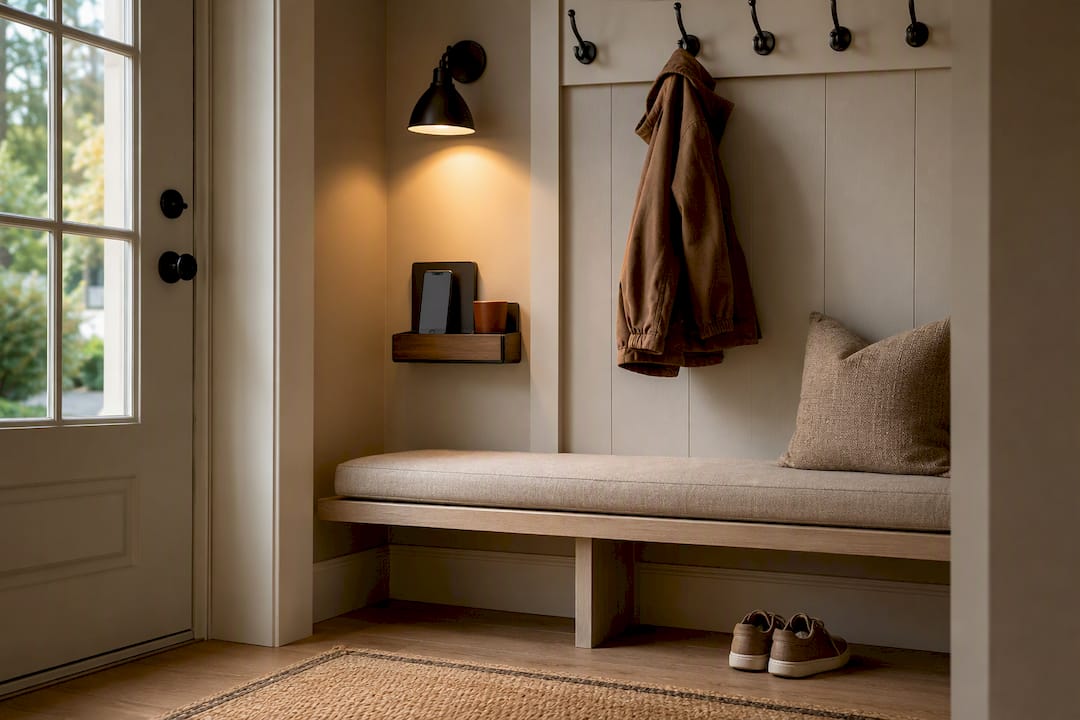
If your entryway includes an organized entryway setup with a bench, hooks, and a charging station, add task lighting directly over that zone. You need enough light to find a phone charger or read a label, which general ambient light from a chandelier ten feet away won't reliably provide.
Traffic flow also affects switch placement, not just fixture choice. A motion sensor or a switch positioned right where you enter, not tucked around a corner, keeps the space functional during the exact moments it gets used most: arms full of groceries, kids in tow, or fumbling for keys in the dark. Match the lighting to how your family actually moves through the space, not to how a showroom foyer looks in a photo.
Maintenance Tips for Foyer Fixtures
Foyer fixtures collect more dust and grime than most people expect, mostly because entries trap outdoor debris every time the door opens. Glass and crystal fixtures need a wipe with a dry microfiber cloth every few weeks to keep light output from dimming under a film of dust; a dirty fixture can lose a noticeable amount of brightness without anyone noticing why.
LED bulbs last far longer than incandescent ones did, often rated for 15,000 to 25,000 hours, so a foyer fixture used a few hours daily might not need a bulb swap for several years. Still, check bulbs seasonally, since flickering or color shift, warm bulbs turning slightly pink or blue, usually signals it's time to replace them before they fail completely.
Metal finishes need different care depending on material. Brass and bronze tolerate a dry dusting most of the time, while glass shades benefit from an occasional glass cleaner. Avoid harsh chemicals on antique or aged finishes, since some patinas are intentional and easy to strip off with the wrong cleaner.
For chandeliers with multiple bulbs, replace them in matched sets when one starts to fail. Mixing an old, dimmer bulb with new ones creates uneven color and brightness across the fixture, which is easy to spot in a foyer where the fixture is the visual focal point of the room.
Energy Efficiency in Foyer Lighting
Foyers usually run lights for short bursts throughout the day, which makes them a good candidate for efficiency upgrades that pay off through convenience as much as savings. LED bulbs use a fraction of the electricity incandescent bulbs did for the same brightness, and they generate far less heat, a real factor in a small enclosed entry.
Motion sensors prevent the common foyer problem of lights left on all day because someone forgot to flip the switch on their way out. Pairing sensors with dimmers and daylight harvesting controls, which automatically adjust brightness based on how much natural light is already coming through a nearby window or transom, can meaningfully cut a foyer's lighting energy draw, part of the same controls-based savings IES documents at the commercial scale and now available in residential smart switches and bulbs.
If you're choosing new fixtures, look for ENERGY STAR rated LED products, which meet efficiency and quality thresholds beyond a generic "LED" label. A dimmable, ENERGY STAR rated bulb in the 2700K to 3000K range gives you both the warmth a foyer needs and the lower energy draw that makes leaving a hallway light on overnight less of a concern.
Safety Considerations for Foyer Lighting Placement
Glare is the most common lighting mistake in foyers, usually from a bare bulb fixture hung at eye level or a pendant positioned directly in a sightline from the front door. Choose fixtures with a shade, frosted glass, or an upward-facing design that diffuses light rather than throwing it straight into someone's eyes as they walk in.
Placement around stairs deserves extra attention. If your foyer opens onto a staircase, make sure the first and last steps are clearly lit, ideally with a dedicated wall sconce or recessed light rather than relying on spillover from the main fixture. Shadows on stairs are a common cause of missteps, especially for guests unfamiliar with your home.
Clearance rules exist for safety as much as style. That 7-foot minimum for hanging fixtures isn't arbitrary. It keeps a chandelier or pendant clear of taller guests and prevents anyone from bumping a light while carrying boxes or furniture through the door.
Finally, keep cords and plug-in fixtures out of the walking path entirely. A plug-in sconce or table lamp is a great renter-friendly solution, but only if the cord runs along a wall or behind furniture rather than across the floor where someone could catch a foot on it.
Using Natural Light and Reflective Surfaces in Your Foyer
Artificial lighting works harder when it isn't fighting a dark room alone. If your foyer has a window, transom, or glass door panel, let it do as much work as possible during the day before layering in lamps and overheads.
Mirrors amplify whatever light already exists in the room, whether that's daylight or your evening fixtures. A mirror positioned across from a window or angled to catch your pendant's glow can noticeably brighten a small entry, a strategy Your Home Revival highlights as one of the most economical upgrades available.
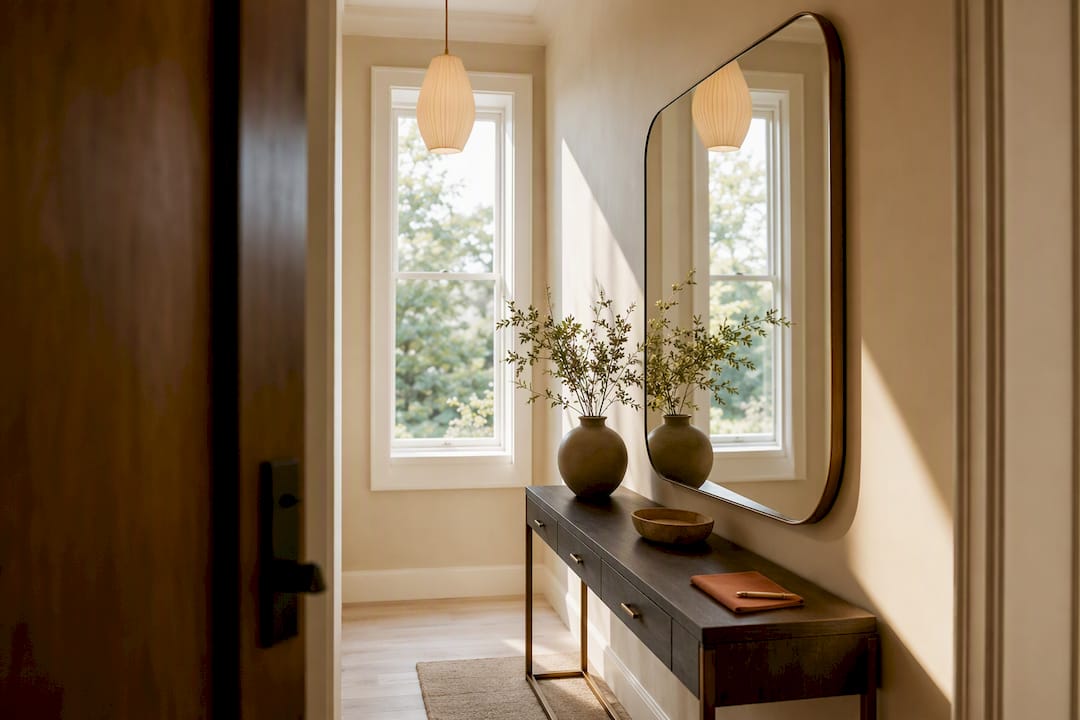
Beyond mirrors, look at your other surfaces. A glossy console table, metallic hardware, or a light-colored floor all bounce light around a room instead of absorbing it the way dark wood or matte black surfaces do. Even a simple switch, swapping a dark rug for a lighter one, can noticeably change how bright your foyer feels at the same wattage.
Our Take on Foyer Lighting Priorities
TheconnectedDwelling's approach to foyer lighting starts with warmth first, because a technically correct lighting plan that feels cold misses the point entirely. Layering comes second: a single fixture, however well chosen, rarely does the job alone. We've seen foyers transform from a harsh, single-bulb glare into a genuinely welcoming entrance just by adding one warm table lamp and swapping to a dimmable bulb, no rewiring involved.
Unobtrusive technology matters too. A motion sensor or smart bulb should improve daily life without announcing itself. For readers building out layers from scratch, our beginner's guide to layered lighting walks through the sequence in more depth.
Find Your Fixture: Curated Foyer Lighting Resources
This guide explains the reasoning behind every fixture choice, not just offering a photo gallery to scroll past. If the sizing formula and clearance rules above answered your practical questions, our lighting resource hub is the next stop for curated fixture picks organized by ceiling height and style.

Ready to build out the layers this article covers? Start with the beginner's guide to layered lighting for a step-by-step walkthrough of ambient, task, and accent light, then check our 2700K versus 3000K breakdown before you buy bulbs. Browse the curated fixtures on the lighting hub now and bring home a foyer that actually feels finished.
Sources
- A science-based approach to controls — IES Lighting and Health Research
- Entryway lighting ideas: a three layer guide — Curated by Hower
- Entryway lighting ideas: pendants, flush mounts & sconces — Glowryte
- Entryway lighting ideas that match your home's style — HGTV
FAQ
What Is the Best Lighting for a Foyer?
The best foyer lighting combines a correctly sized overhead fixture with at least one additional layer, like a sconce or table lamp, using warm bulbs in the 2700K to 3000K range. A single overhead fixture alone tends to flatten the space, according to Curated by Hower's layering guide.
What Kind of Light Should I Put in My Entryway?
Choose warm white LED bulbs between 2700K and 3000K with a CRI of 90 or higher for the most flattering, welcoming glow. Pair them with a dimmer where possible so you can adjust brightness between daytime arrivals and evening ambiance.
What Are the Current Trends in Foyer Lighting?
Current entryway trends favor clustered or tiered pendant arrangements for taller ceilings, warm brass and mixed-metal finishes, and pared-back flush mounts for lower ceilings, patterns visible across HGTV's entryway lighting roundups. Smart bulbs and motion sensors are also showing up more often as easy, renter-friendly upgrades.
What Are Some Good Light Fixtures for a Foyer Area?
Good foyer fixtures depend on ceiling height: chandeliers and clustered pendants for two-story entries, single pendants or medium chandeliers for standard 8 to 9 foot ceilings, and semi-flush or flush mounts for anything lower. Size any hanging fixture using the length-plus-width rule from Glowryte's sizing guide before you buy.


