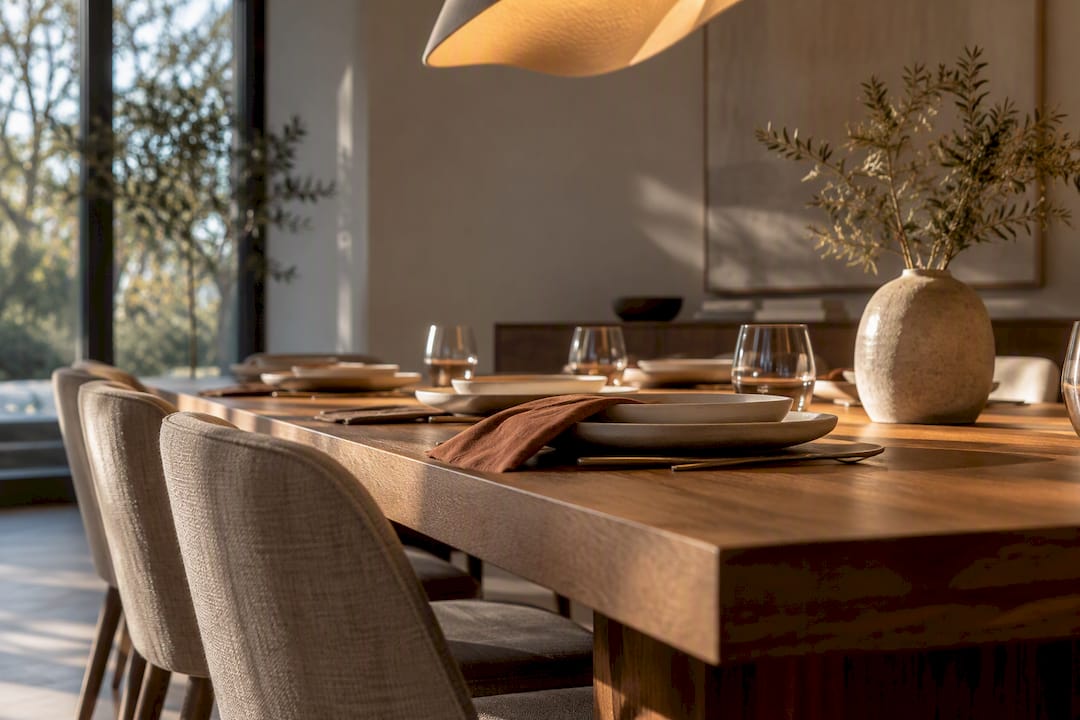
The best dining room lighting is a correctly sized, dimmable pendant or chandelier centered over the table, paired with warm, high-CRI bulbs and a couple of layered supporting lights. Get the size right first: the fixture should span roughly half to two-thirds of your table's width, hung about 30 to 36 inches above the tabletop on a standard 8-foot ceiling. Everything else, style, finish, smart controls, builds on that foundation, and this is a common starting checklist for planning dining spaces.
TL;DR:
- A fixture diameter should be about half to two-thirds of the table's width and hung 30 to 36 inches above the tabletop, adjusted for ceiling height.
- For long rectangular tables over 8 feet, two pendants or a linear fixture are preferable to a single oversized chandelier for balanced proportions.
- Layered lighting with dimmable ambient, task, accent, and decorative lights creates the best atmosphere, with each layer on its own dimmer circuit for flexibility.
- Use warm bulbs between 2700K and 3000K with a CRI of 90 or higher, and aim for about 150 to 300 lumens per seat to ensure optimal lighting.
- Proper fixture support, ceiling clearance, and electrical safety checks are essential, especially for heavier fixtures and vaulted or sloped ceilings.
Table of Contents
- Choosing the Right Fixture Type for Your Dining Room
- Chandelier Size and Hanging Height: The Formulas That Actually Work
- Why Every Dining Room Needs More Than One Light Layer
- Bulb Specs That Actually Change How Your Dining Room Looks
- What's Shaping Dining Room Lighting Design This Year
- Mistakes That Ruin an Otherwise Good Lighting Plan
- Energy Efficiency and the LED Options Worth Considering
- Keeping Your Dining Room Lighting Looking (and Working) Its Best
- Electrical Safety Basics Before You Install
- Picking Lighting Controls: From Basic Dimmers to Smart Scenes
- The Mood-Setting Power of Dining Room Light
- A Design Perspective on Getting Dining Room Lighting Right
- Where to Go Next for Dining Room Lighting Help
- Sources
- FAQ
Choosing the Right Fixture Type for Your Dining Room
Not every table wants a chandelier, and that is fine. The fixture form should follow the shape of your table and the height of your ceiling, not the other way around.
A round or square table under 60 inches usually calls for a single statement piece, a chandelier or a large dome pendant that reads as one focal point. Rectangular tables, especially anything over 7 feet, tend to look better under a linear fixture or two matched pendants spaced along the length rather than one oversized piece stretched to cover the whole table. Clusters of three to five small pendants at varying heights create a looser, more collected look that works well in casual or transitional dining rooms. Wall sconces and flush mounts step in when ceiling height is tight or when a room needs supplemental light without adding visual weight over the table.
A few quick pairings to work from:
- Round table, 8 to 9 ft ceiling: single chandelier or drum pendant, centered.
- Rectangular table, 72 in. or longer: linear fixture or two matching pendants.
- Open-concept dining area: cluster pendants to create a defined "room" within the space.
- Low ceiling, under 8 ft: flush mount or semi-flush fixture to preserve headroom.
Finish matters more than most people expect. Warm brass and bronze read cozier and slightly smaller in scale, while matte black or chrome can feel sharper and visually larger, even at the same physical dimensions.
Chandelier Size and Hanging Height: The Formulas That Actually Work
Sizing a dining fixture is not guesswork. Trade guidance gives you two dependable formulas, one for the table, one for the room, and they usually agree.
For a table-centered fixture, aim for a diameter about one-half to two-thirds of the table's width. A 40-inch-wide table wants a fixture somewhere between 20 and 27 inches across. For a linear fixture over a rectangular table, target 50 to 67% of the table's length rather than its width.
For a room-centered fixture (useful when the table sits within a larger open floor plan), add the room's length and width in feet, then read that sum as inches. A 12 by 14-foot dining room suggests a fixture around 26 inches in diameter.
Quick reference
- Table rule: fixture diameter = 50 to 75% of table width
- Room rule: room length (ft) + room width (ft) = fixture diameter (in.)
- Hanging height: 30 to 36 inches above the tabletop on an 8 ft ceiling
- Add about 3 inches of hanging height per extra foot of ceiling above 8 ft
- Keep at least 7 feet of floor clearance anywhere people walk under the fixture
Here's how to apply it when you're standing in the room with a tape measure:
- Measure your table at its longest, fully extended length, not the collapsed size.
- If the table stretches past 8 feet when extended, consider two matched fixtures instead of one oversized piece.
- Confirm hanging height against your actual ceiling height, not the standard 8-foot assumption.
- Check clearance in any walkway beneath or beside the fixture.
These formulas produce a range, not a single locked number, and most sizing calculators present the result as a range for exactly that reason. Unusual conditions, vaulted ceilings, sloped ceilings, open-plan layouts, are worth a quick call to an electrician or lighting designer before you order anything. These are planning rules, not electrical code.
Why Every Dining Room Needs More Than One Light Layer
A single overhead fixture, no matter how well sized, asks one light source to do a job that really needs four. Dining rooms host homework, dinner parties, quick breakfasts, and long conversations after dessert, and each of those wants a different mood.
Think in four layers:
- Ambient light fills the room generally, often from recessed cans or a central fixture set at moderate brightness.
- Task light sits directly over the table, bright enough to see food and read a menu clearly.
- Accent light highlights art, a buffet, or a china cabinet, usually from a picture light or small directional fixture.
- Decorative light is the mood layer, candles, a lamp on the sideboard, string lights, anything that adds warmth without adding brightness.
Design guidance consistently recommends putting each of these layers on its own dimmer circuit. That separation is what lets you brighten task lighting for a kids' art project at 4 p.m. and drop everything but the accent and decorative layers for a dinner at 8. Wall sconces, buffet lamps, and picture lights work well as that supplemental mid-height layer, filling in the shadows a single overhead fixture always leaves behind.
Pro Tip: If your dining room only has one switch controlling everything, that is the fastest and cheapest lighting upgrade available. A retrofit dimmer costs far less than a new fixture and changes the room's mood more than almost anything else you could buy.
Smart scenes, one tap to shift from "weeknight dinner" to "date night," are a nice add-on once the physical layers and dimmers exist, but they solve a different problem than the wiring does. Get the layering and switching right first.
Bulb Specs That Actually Change How Your Dining Room Looks
The fixture gets the attention, but the bulb inside it does most of the real work. Get the specs wrong and even a beautifully sized chandelier will make your dinner look gray and your guests look tired.
Stick to 2700K to 3000K color temperature. That warmer range flatters skin tones and makes food look appetizing instead of clinical; anything closer to daylight (4000K and up) belongs in a kitchen task area, not over a dinner table.
- Color rendering index (CRI): aim for 90 or above. A CRI 80 bulb, still common in cheaper LED lines, mutes reds and browns just enough that roasted chicken and red wine look slightly off. CRI 90+ renders those colors closer to how they actually appear in daylight.
- Lumens: plan for roughly 150 to 300 lumens per seat. A six-seat table needs about 900 to 1,800 lumens total across all bulbs in the fixture, add more if the fixture sits higher than the standard 30 to 36 inches, or if the room has few other light sources.
- Dimming compatibility: confirm the bulb, driver, and dimmer switch are all rated to work together. Standard LED bulbs paired with an incompatible dimmer flicker or buzz at low settings.
Warm-dimming drivers, which shift toward a cozier color temperature as you dim them, mimic old incandescent bulbs and solve the tension between needing bright task light and wanting a softer glow for evening meals in one bulb.
What's Shaping Dining Room Lighting Design This Year
Warm metals are having a real moment. Aged brass, bronze, and warm gold finishes are showing up more than the cool chrome and matte black that dominated recent years. Design trend coverage points to tactile textures like linen shades, ribbed glass, and hand-thrown ceramic diffusers pairing with these warmer metals, along with sculptural silhouettes that read as art even when the fixture is off.
Clusters and paired linear fixtures continue to replace the single oversized chandelier over long tables, giving a room more visual rhythm without overwhelming the space.
Three pairings worth trying:
- Warm brass chandelier + ribbed glass shades, paired with 2700K bulbs for a soft, collected look.
- Matte black linear fixture over a long table, paired with 3000K bulbs to keep the look modern without feeling cold.
- Cluster of three ceramic pendants at staggered heights, paired with warm-dimming LEDs for a casual, layered glow.
Mistakes That Ruin an Otherwise Good Lighting Plan
Most dining room lighting problems trace back to one of a handful of avoidable errors, and nearly all of them show up before the fixture even goes on order.
The biggest one is scale: a fixture too small for the table or room looks like an afterthought, while one that's too large overwhelms the space and makes the ceiling feel lower than it is. Hanging the fixture too high is a close second, once you clear 36 inches above the tabletop on a standard ceiling, the light spreads too wide and loses the focused pool of light a dining table needs. Non-dimmable LED drivers are the third, buy the fixture, get it installed, then discover it can't be dimmed at all.
Run through this before you check out:
- Measure the table at its longest extended length, not folded.
- Confirm the bulb, driver, and dimmer are all rated compatible.
- Decide single fixture versus two based on whether the table exceeds about 8 feet.
- Book a quick electrician consult if your ceiling is vaulted, sloped, or unusually high.
For extendable tables, size the fixture (or spacing between multiple fixtures) to the table's expanded length, not its everyday size, so the lighting still makes sense when you add the leaf for guests.
Energy Efficiency and the LED Options Worth Considering
LED fixtures have made the old trade-off between good light and low energy use mostly disappear. A modern LED chandelier or pendant uses a fraction of the wattage an incandescent equivalent needed, while still hitting the warm 2700 to 3000K range and CRI 90+ that flatter a dinner table.
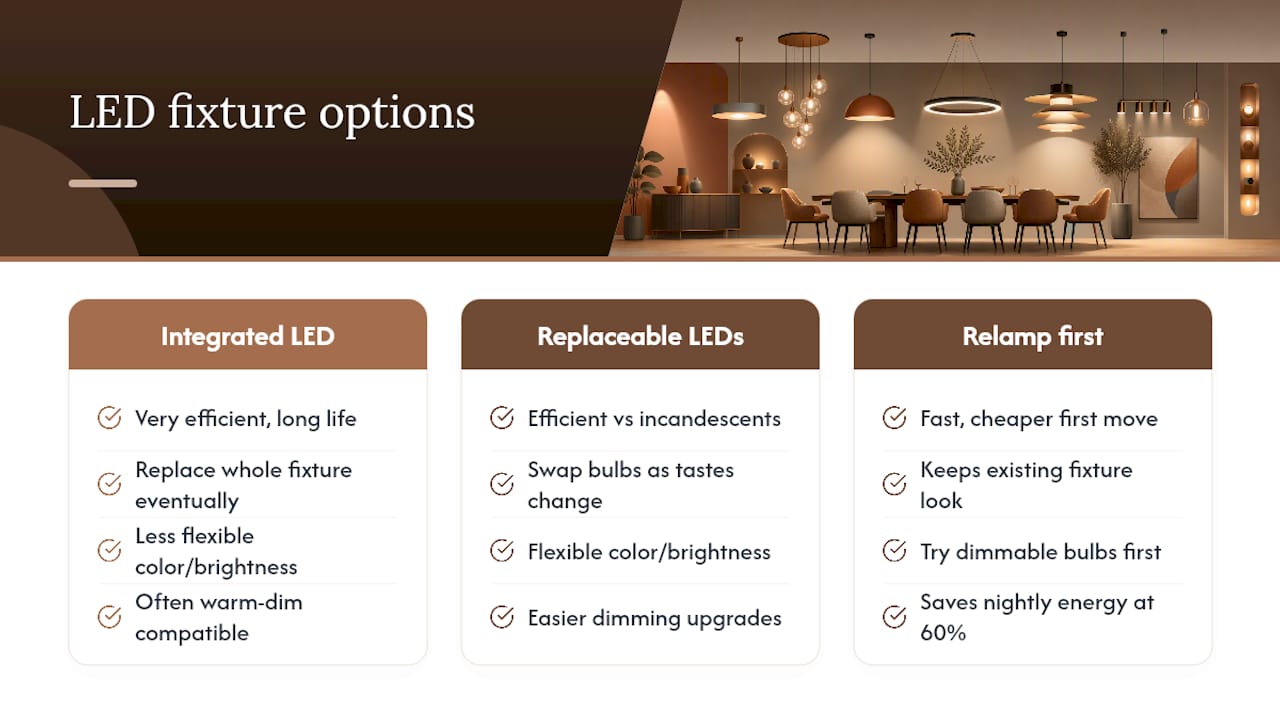
Integrated LED fixtures, where the light source is built into the fixture rather than a swappable bulb, tend to run more efficiently and last longer than fixtures using standard bulb sockets, though they mean replacing the whole fixture eventually rather than just a bulb. Fixtures with replaceable LED bulbs give you more flexibility if your taste in color temperature or brightness changes down the road, and they're the easier upgrade path if you already own a fixture you like the look of.
Look for ENERGY STAR-certified fixtures or bulbs when shopping. That label is a reliable shortcut for confirming a product meets baseline efficiency standards without digging through spec sheets yourself.
Dimmable LED drivers matter here too, not just for mood, but for efficiency. Running a fixture at 60% brightness during a casual dinner instead of full blast saves energy every single night, and warm-dimming drivers let you do that without the light turning harsh or blue as you lower it.
If you're weighing a full fixture replacement against simply relamping an existing chandelier with LED bulbs, the relamp is almost always the faster and cheaper first move. Save the fixture replacement for when the scale, style, or dimming compatibility genuinely doesn't work anymore.
Keeping Your Dining Room Lighting Looking (and Working) Its Best
Dining room fixtures collect more dust and grease than most people expect, thanks to proximity to cooking smells and the simple fact that they hang at eye level where every bit of buildup is visible.
Wipe down glass shades, crystal arms, and metal finishes every few weeks with a soft, dry microfiber cloth. For glass or crystal elements, a mix of mild dish soap and warm water on a cloth (never spray cleaner directly on wiring or sockets) cuts through grease film without leaving streaks. Metal finishes, especially unlacquered brass, can tarnish faster near a kitchen, so check the manufacturer's care instructions before using any metal polish.

Bulb replacement is simpler with LEDs than it used to be, since a quality LED bulb typically lasts years longer than an incandescent one did, but a few habits still help. Replace bulbs in matched sets when one starts to dim or shift color, mismatched color temperatures across the same fixture are one of the more noticeable, avoidable flaws in an otherwise good room. Keep a spare bulb of the exact same spec on hand so a burnout doesn't force a mismatched swap in a pinch.
Before cleaning or changing a bulb, always turn off power at the switch, and for anything beyond a quick dusting or bulb swap, turn off power at the breaker as well.
Electrical Safety Basics Before You Install
Dining room fixtures usually hang directly over where people sit, eat, and lean back in their chairs, which makes proper installation more than a cosmetic concern.
Weight matters most with chandeliers and multi-tier fixtures. Standard ceiling electrical boxes are not rated to support heavy fixtures on their own; anything beyond a lightweight pendant typically needs a fixture-rated ceiling box anchored to a joist or a dedicated support brace. This is exactly the kind of check worth handing to a licensed electrician rather than guessing.
Clearance is a safety issue as much as a design one. The 7-foot minimum floor clearance in walkways exists partly so nobody clips their head walking past a low-hung fixture, and it matters even more in rooms where the dining table sits close to a doorway or hallway.
Dimmer compatibility ties into safety too. Pairing an LED bulb or driver with a dimmer it isn't rated for can cause flickering, buzzing, or premature failure, and in some cases, overheating at the switch. Always check the dimmer manufacturer's compatibility list against the specific bulb or driver you're using rather than assuming any dimmer works with any LED.
Any new wiring, a new ceiling box, moving a fixture location, adding a dimmer circuit, should go through a licensed electrician and, where required, a permit. These sizing and layering rules are planning guidance, not a substitute for code compliance.
Picking Lighting Controls: From Basic Dimmers to Smart Scenes
A standard dimmer switch is the simplest control upgrade, and for most dining rooms, it delivers the biggest change in usability per dollar spent. It requires no app, no hub, and no learning curve, just confirm it's rated for your specific bulb or driver type before installing.
Smart switches and smart bulbs both add scheduling and scene control, but they solve slightly different problems. A smart switch controls whatever bulb is already in the fixture and works well when you want one dependable point of control for the whole room. Smart bulbs put the intelligence in the bulb itself, useful if you want per-bulb color and brightness control within a single fixture, like a cluster of pendants you want dimmed independently.
Scenes are where the layering work from earlier pays off. Once ambient, task, accent, and decorative lighting sit on separate circuits, a smart system can save combinations, "dinner party," "homework," "movie night", as one-tap presets instead of adjusting four switches by hand every time.
Whichever route you choose, confirm compatibility before buying. Not every smart bulb works with every third-party dimmer, and not every smart switch supports every bulb type. Reading the compatibility list on the box takes thirty seconds and saves a return trip to the store.
The Mood-Setting Power of Dining Room Light
Light does more to set the tone of a meal than almost anything else in the room, more than the tablecloth, more than the centerpiece, more than the plates.
Bright, even, cool-toned light says "efficient." It's right for a fast weekday breakfast, but it flattens the mood of anything meant to be lingered over. Dim, warm, focused light says "stay a while." That's the entire logic behind the 2700 to 3000K recommendation and the dimmer circuit: the same fixture, the same bulbs, can shift a room from functional to intimate with one turn of a dial.
Shadow matters as much as brightness here. A single bright overhead light with nothing else on washes out faces and flattens the table. Add a dimmed ambient layer and a warm accent light on a sideboard, and suddenly there's depth, some areas glow, some recede, and the whole room feels considered instead of just lit.
This is really the heart of what layered lighting and correct fixture sizing accomplish together. Size gets the proportions right so the fixture doesn't dominate or disappear. Layering and dimming give you control over the feeling, meal to meal, guest to guest, without ever touching a wrench.
A Design Perspective on Getting Dining Room Lighting Right
Most lighting problems we see in dining rooms trace back to solving for style before solving for scale. A gorgeous chandelier hung too high over an undersized table, wired to a single switch with no dimmer, looks impressive in a showroom photo and falls flat at an actual dinner table. A thoughtful lighting approach starts with the numbers, table width, ceiling height, seat count, because those numbers determine whether the beautiful fixture you fell for will actually work in your room. Get the scale and the dimmer circuit right first, and the style choices that come next have something solid to build on.
Where to Go Next for Dining Room Lighting Help
This resource is built for exactly the moment you're in right now: staring at a table, a ceiling height, and a dozen fixture options, trying to figure out which one actually fits. Unlike a general retailer's product grid, effective guides explain the reasoning behind each recommendation, why a certain size works, why a dimmer changes everything, so you're not just picking a fixture, you're building a lighting plan that holds up over time.

Start with our full lighting resource hub for curated fixture ideas organized by room type and style. If you want the deeper walkthrough on getting ambient, task, accent, and decorative light working together, the Beginner's Guide to Layered Lighting breaks down exactly how to wire and control each layer. Browse either one, or reach out through the site if your room has an unusual ceiling height or layout you'd like a second opinion on before you order anything.
Sources
- Chandelier Buying Guide: Size & Hang — Montclair Light Works
- Lumencalculator
- Dining Room Lighting Ideas: How to Create a Warm, Stylish, and Inviting Space — DecorNesty
- Dining Room Lighting Over Table: 18 Ideas That Work — DecorCrowd
FAQ
What Is the Best Type of Lighting for a Dining Room?
A correctly sized pendant or chandelier over the table, using warm 2700 to 3000K bulbs with a CRI of 90 or higher, paired with a dimmer and at least one supplemental layer like a sconce or buffet lamp. TheconnectedDwelling recommends starting with the sizing math before choosing style, since scale problems are the hardest mistake to fix after installation.
What Is the Current Trend for Dining Room Lighting?
Warm metal finishes, tactile shade materials, and sculptural fixture shapes are leading current design direction, often paired with clusters or linear fixtures over long tables instead of a single centered piece. Dimmable, warm-toned LED bulbs are standard across nearly all of these looks.
How Do I Figure Out What Chandelier Size I Need Over My Table?
Take your table's width and multiply by about one-half to two-thirds to get a target fixture diameter, then hang it 30 to 36 inches above the tabletop on a standard 8-foot ceiling. Add roughly 3 inches of hanging height for every additional foot of ceiling height above that.
How Do I Light Up a Dining Room That Feels Dark or Flat?
Check your bulb specs first, low CRI or cool color temperature bulbs are a common hidden cause of a dull-feeling room, then add a supplemental layer like a wall sconce or buffet lamp to fill the shadows a single overhead fixture leaves behind. A dimmer lets you push more brightness into the room for daily use while still dropping the mood down for evening meals.
Do I Need Two Fixtures Instead of One Over a Long Table?
If your table extends past roughly 8 feet, two matched pendants or a linear fixture usually reads better than one oversized chandelier stretched to cover the whole length. Measure the table at its longest extended setting, since a fixture sized for the collapsed table will look wrong once you add a leaf for guests.


