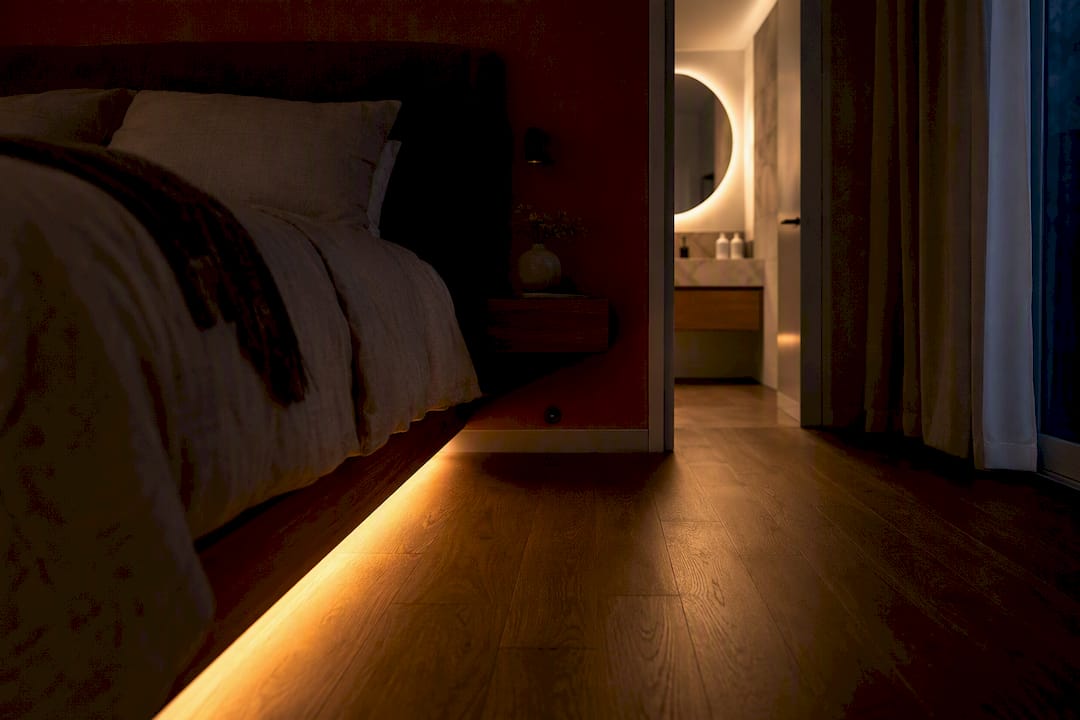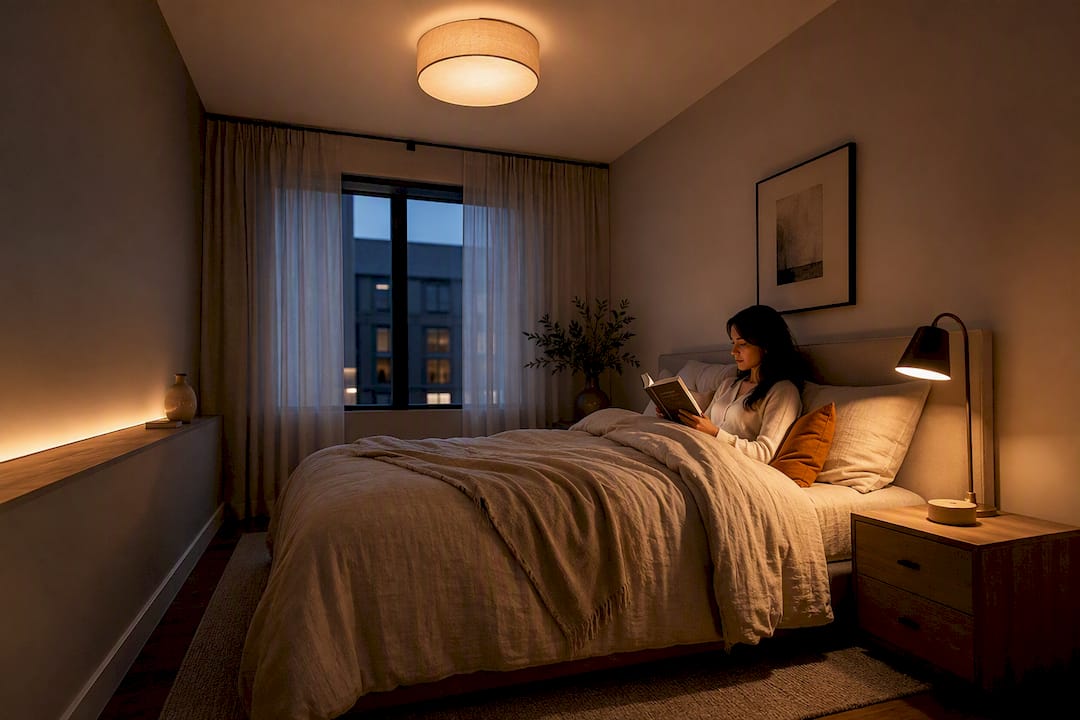
The smartest way to light a small bedroom is layered lighting built from space-saving fixtures, flush mounts, bedside sconces, or hanging pendants, paired with warm, dimmable bulbs. Skip the single overhead bulb approach entirely. A flush-mount ceiling light for ambient glow, wall-mounted sconces or slim pendants at the bedside, and a strip of LED accent light under the bed or headboard can improve a cramped room's function and feel more than any single "statement" fixture. The payoff: a room that reads larger, works harder, and feels calmer at 10 p.m.
TL;DR:
- Installing low-profile flush-mount fixtures and bedside sconces takes priority over central ceiling bulbs to maximize headroom and distribute light evenly.
- Layering ambient, task, and accent lighting with dimmers and warm bulbs enhances room perception and functionality in small bedrooms.
- Cordless, plug-in, and smart lighting options provide renter-friendly, energy-efficient solutions that require no wiring or repairs.
- Proper fixture placement, reflecting daylight with mirrors, and light-colored walls can significantly boost natural light and reduce artificial energy use.
- Avoid bold statement fixtures in favor of matching, space-saving options like sconces and small lamps for a balanced, calming atmosphere.
Table of Contents
- Small Bedroom Lighting Ideas Worth Your Money
- How to Layer Light in a Room With Almost No Space
- Choosing Bulbs, Brightness, and Dimmer Compatibility
- Renter-Friendly Installs and Safe Placement
- The Pre-Purchase Checklist TheconnectedDwelling Uses
- Energy-Efficient Lighting That Won't Spike Your Bill
- Budget-Friendly Lighting Ideas That Still Look Intentional
- Making the Most of Natural Light Before You Flip a Switch
- Electrical Safety Basics Before You Start Drilling
- Design Perspective: Function First, Statement Second
- Where to Find Curated Fixtures Without the Guesswork
- Sources
- FAQ
Small Bedroom Lighting Ideas Worth Your Money
Here's the thing about small bedroom lighting: the room isn't fighting you, your fixture choices are. Most small bedrooms get stuck with one center-ceiling bulb doing three jobs badly. Fix that, and everything else follows. These are the ideas we'd actually spend money on, roughly ordered from "do this first" to "nice upgrade later."
Flush-mount or semi-flush ceiling fixtures. If your ceiling sits at 8 feet or lower, skip anything that hangs down more than a few inches. Low-profile ceiling fixtures preserve headroom and spread light evenly across the whole room instead of pooling it in the middle. Look for a frosted or fabric diffuser so the bulb itself doesn't glare. Price range: $30 to $150.
Bedside wall sconces instead of table lamps. Wall sconces and bedside pendants free up nightstand space that a small room desperately needs for a book, a glass of water, or your phone charger. Hardwired versions need an electrician; plug-in versions don't.
Hanging pendant lights on each side of the bed. Same nightstand-clearing logic as sconces, but with more personality. Swap in a small rattan or glass globe pendant and you get texture without bulk.
Downsized table lamps for the dresser or desk. If a nightstand lamp is non-negotiable, choose one under 18 inches tall with a narrow base. A bulky lamp on a small surface just looks crowded.
Slim floor lamps for corners. A skinny arc or tripod floor lamp tucks into a corner and adds height without eating floor space. Great for reading chairs or dead corners near a closet.
Cordless, USB-rechargeable lamps. These have become genuinely useful for renters. No cord to hide, no outlet required, and most run 8 or more hours on a charge, which makes them ideal for shelves, windowsills, or a nightstand in a room with no nearby outlet.
Under-bed or headboard LED strips. Indirect LED strips and a mirror placed to catch daylight boost perceived brightness without adding a single visible fixture. Run a strip along the underside of the bed frame or behind the headboard for a soft glow that reads as expensive.
String lights for low-key accent mood. Not just for dorm rooms. A warm-white string tucked along a shelf or wrapped around a bed frame post adds ambiance for almost nothing.
Swivel or swing-arm reading lights. If you share the bed with a partner who sleeps earlier than you do, a swing-arm lamp clamped to the headboard or wall lets you read without lighting up their side.
Mini accent spotlights for shelves and art. Small picture lights or puck lights tucked above a shelf give the room a gallery touch and highlight things you actually want seen.
Multifunction fixtures with built-in dimmers or USB ports. A lamp with a built-in dimmer switch or a sconce with a charging port cuts down on the clutter of extra cords and separate dimmer plugs.
Budget guidance: expect $20 to $60 for basic plug-in sconces and cordless lamps, $60 to $150 for quality flush mounts and pendant pairs, and $150 and up for designer fixtures or smart-enabled options. Always check the fixture's mounting depth and bulb base (usually E26) before you buy. Small differences in dimensions matter more in a small room than anywhere else in the house.
How to Layer Light in a Room With Almost No Space
Layering three types of light, ambient, task, and accent, is the baseline that makes small bedrooms both more functional and visually larger. Ambient light fills the room evenly. Task light targets a specific job like reading or getting dressed. Accent light adds depth and mood.
Build it in this order:
- Start with ambient: a flush-mount ceiling fixture on a dimmer.
- Add task light: bedside sconces or a swing-arm lamp positioned where you actually read.
- Finish with accent: an LED strip under the bed, behind the headboard, or along a shelf.
For an alcove bed, mount sconces on the flanking walls and skip a ceiling fixture entirely if the alcove is shallow. In a standard 10 by 12 room, a flush mount centered on the ceiling plus two bedside sconces covers most needs. In a shared small bedroom, give each side of the bed its own swing-arm light so one person's reading habit doesn't run the other's bedtime.
Pro Tip: No budget for an electrician? Smart bulbs in existing sockets, plug-in dimmer switches, and clamp-on task lamps let you build all three layers without touching a single wire. For the full breakdown, TheconnectedDwelling's guide to layered lighting walks through room-by-room examples.
Choosing Bulbs, Brightness, and Dimmer Compatibility
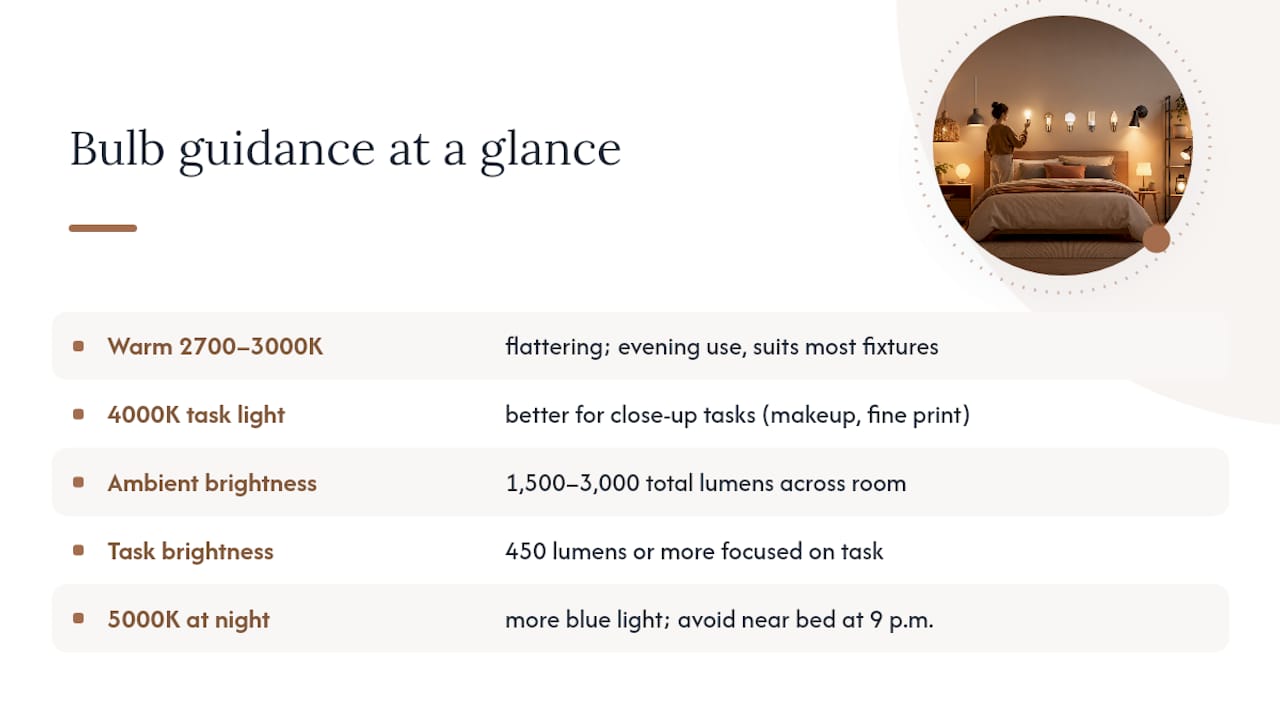
Warm light in the 2700K to 3000K range flatters skin tones and suits evening use, while a cooler 4000K bulb works better for close-up tasks like makeup or reading fine print. Most small bedrooms should stay warm across every fixture, with maybe one task light running slightly cooler.
For brightness, aim for roughly 1,500 to 3,000 total lumens spread across the room for ambient light, and 450 lumens or more focused directly on a task like reading. Before buying dimmable bulbs or smart bulbs, confirm the fixture and switch are dimmer-compatible. Not all LEDs dim smoothly, and mismatched dimmers cause flicker or buzzing. Warm color temperatures reduce exposure to the blue light that can interfere with the body's production of melatonin, which is exactly why a 5000K bulb over your bed is a bad idea at 9 p.m. For a deeper comparison, see TheconnectedDwelling's breakdown of 2700K versus 3000K.
Renter-Friendly Installs and Safe Placement
You don't need to touch a wire to upgrade a small bedroom. Plug-in sconces, clamp lamps, and cordless lamps deliver renter-safe lighting with zero drilling into circuits, and cordless options work well on shelves or nightstands with no outlet nearby.
- Mount bedside sconce shades roughly 60 to 66 inches off the floor, at eye level when seated in bed.
- Leave an 8 to 12 inch drop from the ceiling for pendants in rooms with 8 foot ceilings, so you don't bump your head getting up.
- Keep cords tucked along a wall track and give any fabric shade a few inches of clearance from bedding.
- Call an electrician for hardwiring, adding a new switch leg, or installing an in-wall dimmer. Anything past a plug-in swap is worth the service call.
The Pre-Purchase Checklist TheconnectedDwelling Uses
Before you order anything, measure your ceiling height, the top of your bed frame, and the wall space beside it. Confirm the fixture's mounting type, dimmer compatibility, bulb base, and maximum wattage, and check whether the ceiling needs blocking for a heavier fixture. TheconnectedDwelling's lighting hub covers the fixture types in more detail if you want to compare options before you buy.
Energy-Efficient Lighting That Won't Spike Your Bill
LED bulbs are the obvious starting point, using a fraction of the electricity of an old incandescent bulb while lasting years longer. For a small bedroom running two or three fixtures a few hours a night, that difference adds up over a year without you noticing any change in brightness.
Look for ENERGY STAR-certified bulbs and fixtures when shopping. That label means the product met federal efficiency benchmarks for both light output and standby power draw, so you're not guessing at performance claims printed on the box.
Smart bulbs add another layer of efficiency, not just through lower wattage but through scheduling. A bulb that automatically dims at 9 p.m. and turns off by midnight uses less power than one left burning on a switch someone forgot about. Motion sensors on closet lights or under-bed accent strips do the same job passively, lighting up only when needed instead of running all evening.
Dimmer switches themselves save energy too, since a bulb running at 50 percent brightness pulls meaningfully less power than one at full output. Pair that with warm LED bulbs already recommended for sleep quality, and you get a bedroom that's both cozier and cheaper to light. The efficient choice and the flattering choice turn out to be the same choice here, which doesn't happen often in home design.
Budget-Friendly Lighting Ideas That Still Look Intentional
You can transform a small bedroom's lighting for well under $100 if you're strategic about where the money goes. Spend on the fixtures that touch your eyes directly, bedside sconces or a reading lamp, and save on the ambient layer, where a basic flush mount with a warm bulb does the job just as well as an expensive one.
String lights are the cheapest accent option available, often running $10 to $20 for a warm-white set, and they add mood lighting that a single overhead bulb can't replicate. A secondhand or thrifted lamp base gets new life with a $5 bulb swap to warm LED and a $10 shade if the original one is dated or stained.
Command-strip mountable sconces and battery-powered puck lights avoid installation costs entirely and can be moved or removed without a landlord ever knowing they existed. If you're set on a pendant but nervous about wiring, a plug-in pendant kit lets you hang the same look from a hook without an electrician, using the cord as part of the design rather than hiding it.
The biggest budget mistake is buying one bright ceiling fixture and calling it done. Splitting the same money across two or three smaller sources, a sconce here, a lamp there, an LED strip somewhere else, gets you better light quality and more flexibility than a single expensive fixture ever will.
Making the Most of Natural Light Before You Flip a Switch
Artificial lighting works harder when it's not fighting against a dim room all day. Keep window treatments light and sheer where privacy allows, since heavy blackout curtains left half-closed during the day block far more daylight than most people realize.
Mirrors placed opposite or beside a window bounce daylight deeper into the room, which is especially useful in a small bedroom where the window wall is often the only bright spot. A mirror angled to catch afternoon light can noticeably brighten a corner that would otherwise need a lamp running around the clock.
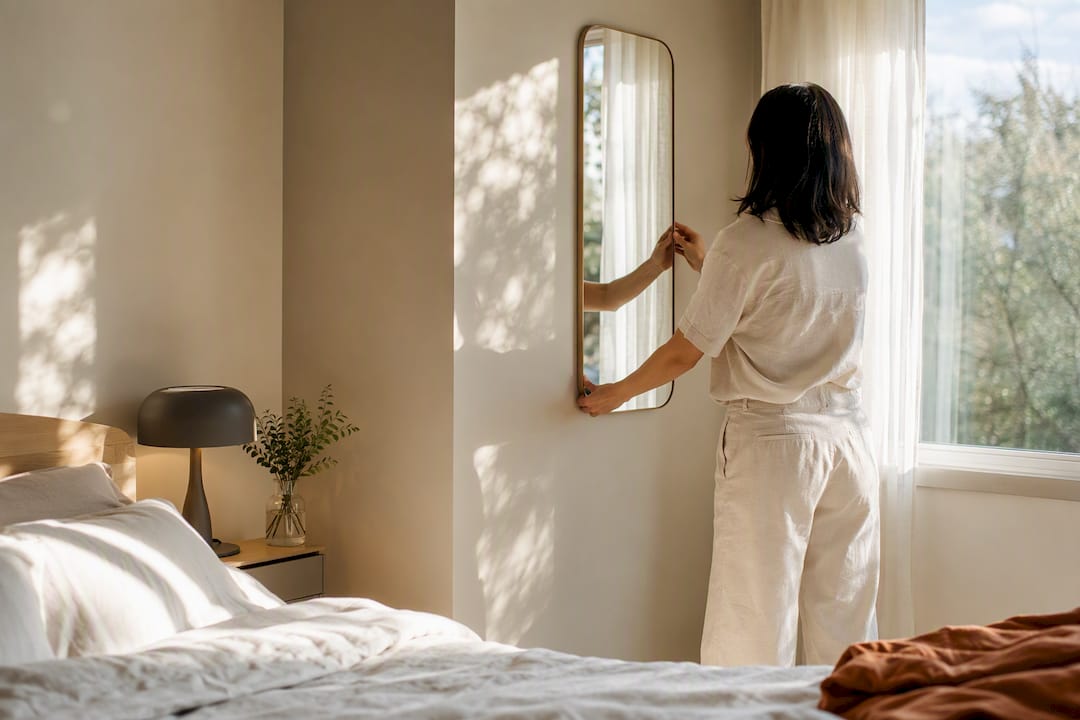
Keep furniture and tall décor away from window sills so light isn't blocked before it even enters the room. If privacy is the reason your curtains stay shut, consider a sheer layer for daytime and a heavier blackout panel you close only at night, giving you both control and daylight when you want it.
Light-colored walls and a glossy or satin paint finish, rather than flat, reflect more of both your natural and artificial light around the room. That single change, repainting one wall in a lighter shade, can measurably reduce how much artificial light you need to run during the day.
Electrical Safety Basics Before You Start Drilling
Anything beyond swapping a bulb or plugging in a lamp deserves a moment of caution. Never exceed the maximum wattage listed inside a fixture, printed near the socket, since overdriving an old fixture with a too-hot bulb is a real fire risk even with LEDs.
Check that any dimmer switch you install is rated for the bulb type you're using. LED-compatible dimmers are different from the old incandescent-rated ones, and mismatching them can cause flickering, buzzing, or premature bulb failure.
If you're hanging anything heavier than a basic flush mount, confirm the ceiling box has proper blocking or a fan-rated brace behind it. Drywall alone won't hold a substantial pendant safely over a bed. For string lights or LED strips run near bedding, keep any transformer or driver box away from fabric and never tuck it under a mattress where heat can build up.
Anything involving new wiring, a new switch leg, or moving a junction box belongs to a licensed electrician. That's not a place to save $150 with a weekend DIY attempt, particularly in a bedroom where you're asleep for eight hours a few feet from the fixture.
Design Perspective: Function First, Statement Second
Save the sculptural pendant for rooms with breathing room. In a genuinely small bedroom, a low-profile flush mount and a matched pair of sconces, placed symmetrically, do more to make the room feel larger than one bold fixture ever will.
Pro Tip: A woven rattan shade or a brushed-brass sconce adds texture without adding visual weight, so the room still feels calm even with light coming from three directions.
Where to Find Curated Fixtures Without the Guesswork
Shopping for small-bedroom fixtures means sorting through hundreds of options that all claim to be "space-saving." TheconnectedDwelling skips the noise: our Recommended Products page lists fixtures, bulbs, and dimmers that have already been vetted for scale, dimmer compatibility, and warm color temperature, the exact criteria this guide just walked through.

If you want the deeper technical walkthrough before you buy, start with the layered lighting guide to plan your ambient, task, and accent sources room by room. Once you know what you need, head to the product picks, filter by fixture type, and check the listed dimensions against the ceiling height and bed measurements you already took. That's the whole process: plan the layers, then shop the list.
Sources
Practical measurements and layering guidance for this piece came from The Spruce, Wayfair Ideas, Build-Construct, and Katrina Blair, plus design-trend context from One Day Doors & Closets.
- Small Bedroom Lighting Ideas That Make Tight Rooms Feel Larger — Build-Construct
- Smart Small Bedroom Lighting Ideas for Cozy, Functional Spaces | Wayfair
- 15 Small Bedroom Lighting Ideas — The Spruce
FAQ
What is the best type of lighting for a small bedroom?
Layered lighting works best: a flush-mount ceiling fixture for ambient light, bedside sconces or pendants for task light, and LED strips or string lights for accent. No single fixture handles all three jobs well.
What is the 5'7" lighting rule?
The rule refers to hanging a pendant or fixture so its bottom edge sits close to eye level for an average adult standing beside it, which in small bedrooms generally lines up with the 60 to 66 inch sconce height mentioned earlier in this guide.
What are some good lighting ideas for a small room?
Flush-mount ceiling fixtures, wall sconces instead of table lamps, under-bed LED strips, and cordless rechargeable lamps all save space while adding layered light. String lights and mini accent spotlights add mood without extra floor or nightstand clutter.
What is trending in bedroom lighting?
Warm, dimmable LED fixtures with smart controls are currently popular, along with sculptural sconces in woven or brushed-metal finishes and hidden LED strips for headboard or under-bed glow.
## Recommended